



True Albino Melmac (TAM) | Albino P. cubensis Melmac-Line Genetics
Ghost‑white Melmac expression with a storied “TAM Project” pedigree.
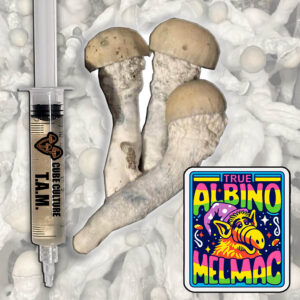
True Albino Melmac (TAM) is a sought‑after Psilocybe cubensis genetic line known for its striking albino phenotype—pale stems and caps that can range from chalk‑white to silver‑gray—paired with the chunky, characterful “Melmac / Penis Envy family” morphology that many researchers recognize at a glance. In community lineage discussions, TAM is commonly linked to work that combines Melmac genetics with the “True Albino Teacher (TAT)” lineage, and it has also been described as a stabilized albino isolation within the broader Melmac family.
Genetic Lineage & Historical Context
- Species: Psilocybe cubensis
- Lineage status: Melmac / Penis Envy family derivative with a stabilized albino expression (“TAM Project” lineage discussions)
- Commonly reported lineage notes: Often described as a cross involving True Albino Teacher (TAT) × Melmac, and/or an albino isolation selected from Melmac‑type genetics.
Because hobbyist genetics are frequently traded and renamed, “TAM” is best treated as a community lineage label. The most consistent identifiers across sources are its albino phenotype and Melmac‑style macro morphology.
Visual Characteristics (Macro Morphology)
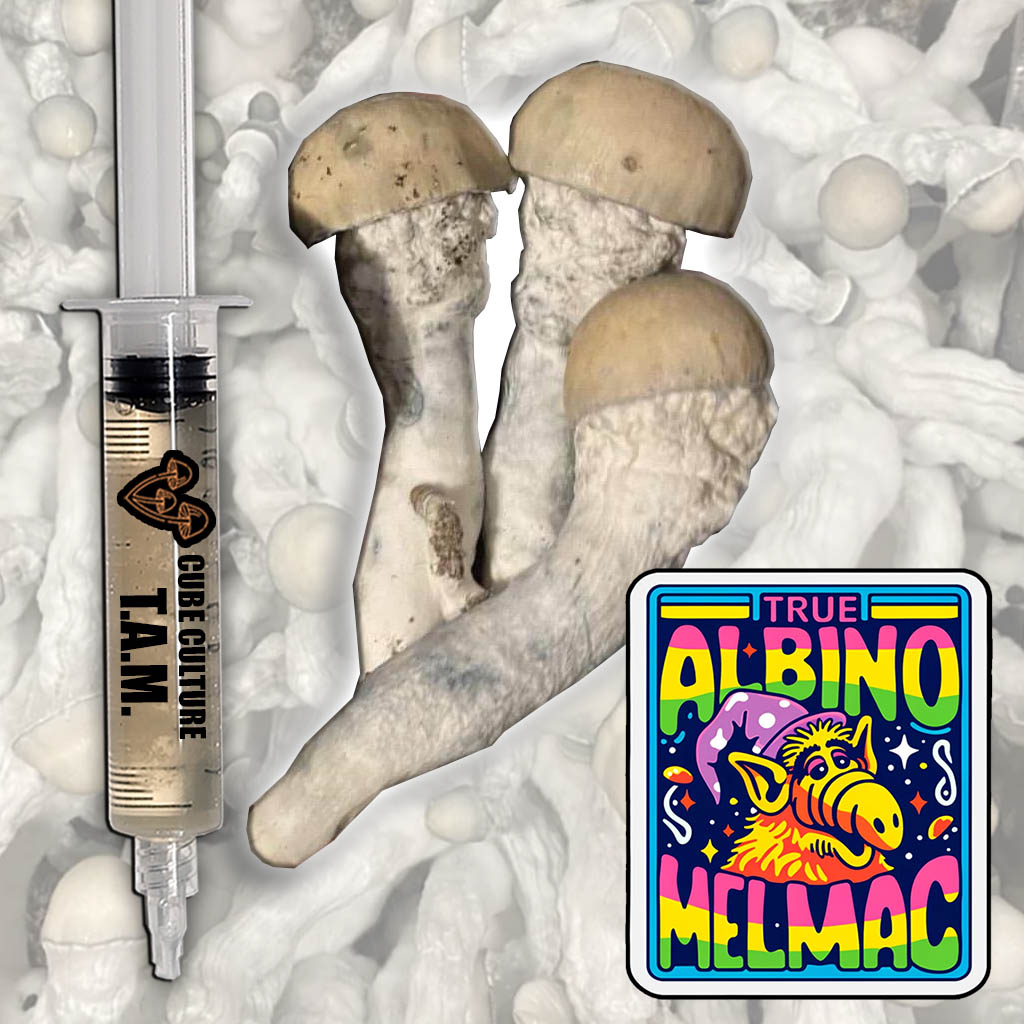
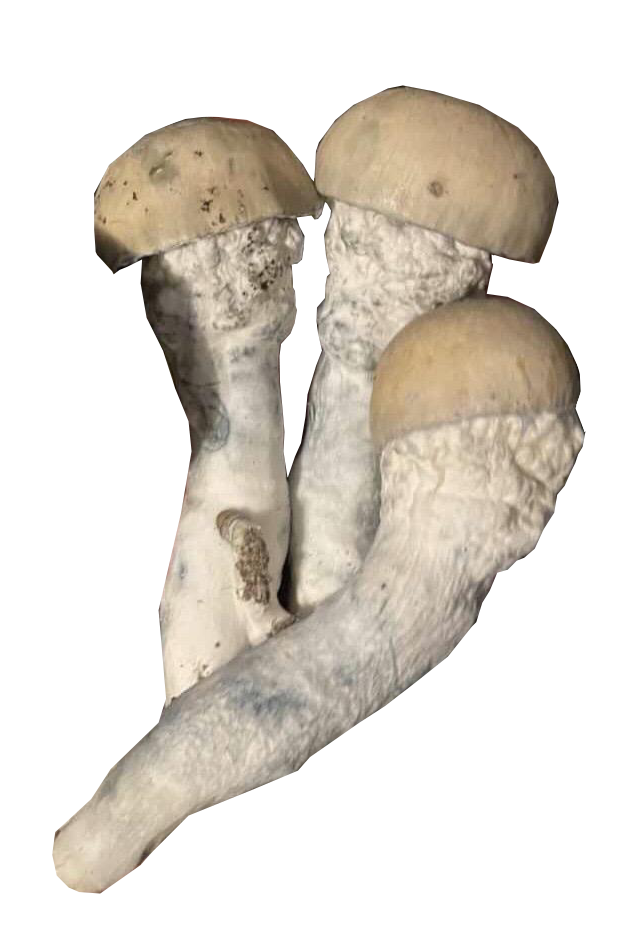
- Overall coloration: Albino / near‑albino—white to ivory body tones; caps may present a gray‑to‑silver hue under certain lighting.
- Cap shape: Often compact and rounded when young, becoming broader with maturity; “Melmac‑family” caps may look thicker and more sculpted than classic cubensis forms.
- Stem (stipe): Frequently described as thick, sometimes bumpy / textured, with a dense, sturdy look typical of Melmac‑type genetics.
- Veil remnants: Partial veil remnants may be present (varies by isolation and maturity)
- Bruising: Blue oxidation may be observed where handled or damaged (a common P. cubensis field/bench observation)
Microscopy & Taxonomy Notes
- Taxonomy: Psilocybe cubensis (cubensis‑type basidiomycete with standard cubensis spore morphology)
- Spore print color (general cubensis reference): Dark purplish‑brown; albino fruit body coloration does not necessarily imply colorless spores
- Why TAM is interesting for observation: The combination of a rare albino phenotype and Melmac‑family macro traits makes it useful for comparative morphological study against “classic” cubensis baselines.
Research Notes (Educational Context)
Educational and descriptive context only.
- Potency (reported): Commonly discussed as high in anecdotal community literature, consistent with its association to the Melmac / Penis Envy family. (Reports vary by isolation and conditions.)
- Common descriptive language: Terms like “intense,” “deep,” and “long‑lasting” are frequently used in informal strain descriptions; treat these as subjective and non‑standardized.
- Lineage relevance: TAM is regularly mentioned alongside other “TAT × Melmac” derivatives (e.g., MVP, AMVP) that are grouped under the broader “TAM project” umbrella in some vendor/community write‑ups.
Cultivation Characteristics (High-Level Overview)
- Difficulty (reported): Often described as more “patience‑testing” than beginner classics, with some growers reporting slower timelines compared to typical cubensis.
- Growth behavior (reported): Dense, thick‑bodied fruits are commonly associated with Melmac‑family lines; expression can vary by isolate.
- Notes on variability: Because “TAM” can refer to different isolates across the community, phenotypes may range from near‑albino to full albino and from classic‑leaning to heavily Melmac‑leaning forms.
For safety and compliance, this section is descriptive only and excludes instructions, parameters, or cultivation techniques.
Collector & Researcher Highlights
- Albino Melmac expression: A visually distinctive “ghost” phenotype paired with Melmac‑family structure.
- Genetic offshoots: Some sources attribute later isolations such as Gandalf, MVP, and Pearly Gates to TAM‑related work.
- Abbreviation: Commonly referred to as TAM
Why liquid culture over spores (for research):
- Established genetics: supports consistent morphological comparison across repeated observations
- Cleaner observation: minimal extraneous material for microscopy prep – Made in front of a scanned, 99.99% efficient HEPA filter
- Reliable phenotype tracking: useful when documenting albino vs. near‑albino expression
- Shelf Life: Use within 2 months for best results; 70-day viability guarantee when stored properly; may remain viable up to 12 months refrigerated (not guaranteed). DO NOT FREEZE.
Shipping: Fast and Free USPS shipping including all territories including Puerto Rico, U.S. Virgin Islands, Guam, Northern Mariana Islands, and American Samoa. Expedited USPS Priority options available. Products shipped daily (see our Shipping FAQ page for shipping times and questions) No cheap culture and outrageous shipping cost. What you see is what you pay.
- Satisfaction guarantee on all orders
- Military & First Responder discount available
- Shroomery verified & trusted vendor with 100,000+ cultures shipped
- See what our customers say about us!
- All payment methods are accepted, including cash, money order, debit, credit, cryptocurrency at checkout, Cash App, and Venmo.
Important: Products are strictly intended for microscopy and taxonomy research only. Do not use where prohibited by law. None of our products contain any illegal or active alkaloids at the time of shipment.
Add True Albino Melmac to your genetic library for standout albino morphology and Melmac‑line comparative study.
Parent & TAM-Family Lines We Carry
True Albino Melmac sits at the center of a small family of TAT × Melmac lines. These are its parents and closest relatives on the shelf:
- Melmac – the pigmented PE-family parent, and the reference for TAM’s dense stems and compact caps
- Yeti (TAT Isolation) – a True Albino Teacher isolation from the same breeder, showing the albino parent side without Melmac
- AMVP (Albino MVP) – another albino line reported as TAT × Melmac, for comparing two outcomes of a similar pairing
- Lucid Gates – an albino from the Pearly Gates line, which some accounts trace to the TAM project
Collecting the family? Add the matching True Albino Melmac vinyl sticker – and every order includes a free random sticker regardless.
Frequently Asked Questions
What is True Albino Melmac crossed from?
TAM is a Melmac / Penis Envy family derivative carrying a stabilized albino expression, commonly reported as a True Albino Teacher × Melmac line. Community sources associate it with the selection work often referred to as the “TAM Project.”
How does TAM differ visually from Melmac?
Melmac shows the golden-brown coloration typical of PE-family cubensis, while TAM presents a ghost-white to pale albino body. The underlying build — thick, dense stipes and compact cap development — stays recognizably PE-family in both.
What is the difference between a liquid culture and a spore syringe?
A spore syringe carries spores suspended in solution. Spores are genetically varied and have to germinate before any mycelium exists, so what develops can differ from sample to sample. A liquid culture contains living mycelium from a single isolated genetic line that has already been grown out, so you are working with a known, consistent expression from the start and there is no germination stage. For microscopy and taxonomy work that means repeatable observation of the same genetics rather than a mixed population. Every culture we prepare is made in front of a scanned, 99.99% efficient HEPA filter.
How long will my liquid culture stay viable, and how should I store it?
We recommend using your culture within 2 months of receipt for best results. When stored properly it is covered by our 70-day viability guarantee, and properly stored cultures can remain viable for up to 12 months, although viability beyond 70 days is not guaranteed. Keep it refrigerated between 33-40°F and never allow it to freeze. Most cultures survive a single freeze-thaw cycle, but repeated freeze-thaw cycles will kill live mycelium.
What happens if my culture arrives contaminated or does not work?
Every batch is verified contamination-free before it ships, and your order is covered by our 70-Day Guarantee. If a culture arrives contaminated or fails to perform within that window, contact us and we will arrange a replacement or refund. Full terms are set out on our Refund & Replacement Policy page.
Who created True Albino Melmac?
TAM is commonly associated with Jik Fibs, the grower credited with finding True Albino Teacher, and some catalogs list it as TAM Fibs OG. By accounts shared on the Shroomery forum, he went on to combine his TAT genetics with Melmac in what became known as the TAM project. As with most modern lines, the details come from breeder and community accounts rather than formal documentation.
What other lines came out of the TAM project?
Forum accounts from 2020 list several isolations associated with the TAM project, including Pearly Gates, Gandalf, Blue J and Blue Moon. Pearly Gates went on to become the foundation of Emerald Gates and Lucid Gates, and Gandalf is one parent of Gorilla Wizard. Other sources credit Pearly Gates to a different breeder, so these links are best treated as reported.
What do TAM spores look like under the microscope?
Shape and size should follow the species: smooth, subellipsoid, roughly 11 to 17 micrometers long by 7 to 12 wide, with a germ pore. With True Albino Teacher in its background, spores may be paler than the usual dark purple-brown, and the Melmac side can make collections lighter, so record what you actually see.
Have a question we have not covered here? See our full FAQ page.
Additional Information & Research Resources
Documented Origin & Disputed History
True Albino Melmac brings together two lines with very different histories. On one side is Melmac, a Penis Envy selection distributed by a company called Homestead in the 1980s. On the other is True Albino Teacher, found around 2017 by the grower known as Jik Fibs when white fruits appeared in an ordinary Golden Teacher grow and later produced near-translucent spores. By accounts shared on the Shroomery forum, Jik Fibs then combined his TAT genetics with Melmac in what became known as the TAM project, and TAM is still sold by some catalogs as TAM Fibs OG.
The TAM project is also credited in those accounts with several other isolations, including Pearly Gates, Gandalf, Blue J and Blue Moon. Other sources credit Pearly Gates to a different breeder, Michael Montgomery, so the family tree is not settled. We present the history as the community records it rather than as settled fact.
What the Genetics Suggest
No published study has sequenced TAM, but both parents come from well-characterized groups. McTaggart and colleagues, writing in Current Biology in 2023, found that cultivated P. cubensis sorts into two broad clusters: one holding Golden Teacher and its relatives, the other holding the P-envy population, which showed the strongest signal of clonal propagation and the highest inbreeding coefficient of any group studied. True Albino Teacher comes from the Teacher side and Melmac from the PE side.
In plain language: TAM is a bridge between the two main branches of cultivated cubensis, with an albino trait carried over from the Teacher side and body shape largely from the PE side. That pairing has proved so useful that several other lines on the shelf, including AMVP and Lucid Gates, are built on the same idea.
TAM’s Place in Modern Breeding
Few recent lines have had as much downstream influence. Through the isolations associated with the TAM project, TAM-family genetics are reported in the background of Pearly Gates, Emerald Gates and Lucid Gates, and one of the TAM-project isolations, Gandalf, is a parent of Gorilla Wizard. Running TAM beside those descendants is a practical way to see which traits carried through.
What Analytical Testing Shows
There is no published data on TAM itself. The closest peer-reviewed reference points come from a 2026 study in the Journal of Fungi by Sharchaton and colleagues, which grew 14 cubensis strains under identical conditions. It included lines from both sides of TAM’s pedigree: Penis Envy measured 17.59 mg/g total tryptamines, while the TAT-family Jack Frost measured 4.95 mg/g and Jack Frost × Golden Teacher 11.38 mg/g. Totals across the study ranged more than 7.8-fold. Neither side of a TAT × PE-family pedigree predicts the result on its own, and TAM potency claims should be treated as unverified until specific testing exists.
Microscopy & Culture Reference Notes
- Spore data: expected within the normal P. cubensis range of roughly 11–17 x 7–12 micrometers, subellipsoid and smooth-walled; published TAM-specific measurements are not available
- Pigmentation: may be paler than typical given the TAT background; record what you actually see
- Macro reference: pale, near-white fruiting bodies; thick, dense PE-type stems; compact caps slow to open; strong blue bruising against pale tissue
- What is observable without spores: vegetative structure – septate hyphae, branching habit and the clamp connections of a dikaryotic basidiomycete
- Suggested workflow: 100x to survey coverage, 400x for spore and gill morphology, 1000x oil immersion for measurement, germ pore and clamp connection detail
- Comparative value: run beside Melmac and Yeti to see which traits come from each side of the pedigree
True Albino Melmac on Video
Background viewing from third-party creators. TAM-specific footage is scarce, so coverage of its two parent families comes first, then technique:
- Melmac Mushrooms: What Are They? – DoubleBlind, 10 min. An overview of the Melmac Penis Envy parent line.
- Ghost Mushrooms Review – April Pride, 12 min. Covers a True Albino Teacher isolation, useful background on the albino side of the cross.
- The True Story of the Penis Envy Mushroom – Hamilton Morris, 2 hr 45 min. A long-form 2022 interview on the origin of the PE family behind Melmac.
- Penis Envy Mushrooms – DoubleBlind, 7 min. An introduction to the PE family and why PE-type mushrooms look and behave differently.
- The Science of Strains: Golden Teacher vs. Penis Envy – Wonder Fungi, 5 min. Compares the two branches of cultivated cubensis that TAM combines.
- Fungal Microscopy: How to Mount a Slide, View and Measure Spores – Oregon Mycological Society, 5 min. Not strain-specific, but essential technique for documenting pale or sparse spores.
These are third-party videos. We are not affiliated with any of these creators and do not control their content. Links are provided for historical and educational context only.
Important Notice:
Once home, cubensis cultures should be kept in a fridge between 33-40°F to maximize their lifespan. We recommend using them within 2 months. Viability is guaranteed for 70 days when stored properly, and properly stored cultures can last up to 12 months, but this is not guaranteed.
Do not let your cultures freeze! While most will survive one freeze-thaw cycle, multiple freeze-thaw cycles will kill any live mycelium.
This product description is provided strictly for educational, historical, and scientific context. Products are intended for microscopy and taxonomy research only. Not for cultivation or consumption.
We are not able to offer any cultivation or growing information or advice. Any such requests will be ignored.
Please comply with all applicable local, state, and federal laws.






Jessica G. –
I love this company! The shipping is almost always same day, it's always free shipping, the customer service is amazing, their products are great and free from contamination. The only way I would ever order from anyone else is if they happen to not have a strain I was particularly interested in. I'm looking for z strain right now and I don't have it so I'm forced to look elsewhere. But that is the only circumstance under which I would order from anyone but cube culture.
Christina M. –
I love them! Everything has worked out perfectly no contamination easy. I'm already in fruiting stage I'm super excited to see the end result!
Charles –
Best genetics, best customer service, fastest shipping and delivery, discreet packaging if youƒ??re worried about neighbors, and ALWAYS have better than expected timeframes. 100% my go-to company from here on.
Dylan B. –
BARE IN MIND I wouldn't normally leave a sour review, I know we all have busineses to run and such, plus good vibes are pretty much all I throw, But having received a 2nd paid order of this culture I can tell you is that I cleaned my condenser lens added a darkfield light to my oservation area,( used several different machines to obeserve my samples and even the trusty halogen backlight and I observed that the fungal culture appears to exhibit an unusually high degree of growth variability and atypical morphological characteristics, suggestive of the presence of trich and slime mold contaminants. The unexpected emergence of undesirable microorganisms in the culture may negatively impact its usefulness for intended purposes. If it comes into question that I may be the cause, I asure you that I followed the a.s.h.a audiology infection prevention religiously for my iso8 modular cleanbooth. I also gain nothing from telling you falsehoods. =( to sum it up I believe your culture for this specific set of genetics chas been comprimised.
Ben B. –
The culture seems to be inactive as the temperate may have ruined it unfortunately
NoccedUp –
Seems to be damaged
NoccedUp –
This is just a follow up of my previous review. I ordere the TAM the first time a few weeks back, and it wasnt viable for whatever reason. I hit them up and they relaced the order PLUS suprised me with a WHOLE EXTRA CULTURE OF JMF. I took them both to agar and they both produced results in less than 72 hours, i can assure anybody wondering that these guys are the real deal!
Garrett K. –
Awesome
Nathaniel D. (verified owner) –
Fast shipping! The product looks amazing under the slide, and it grows fast and with a sense of purpose . I would recommend strongly !
James W. (verified owner) –
Great deal, looking forward to see how it does.
Gabriel (verified owner) –
Shipping was faster than I anticipated. Haven’t used the cultures yet, as they just arrived, but I’m looking forward to conducting some microscopic research with the mycelium