
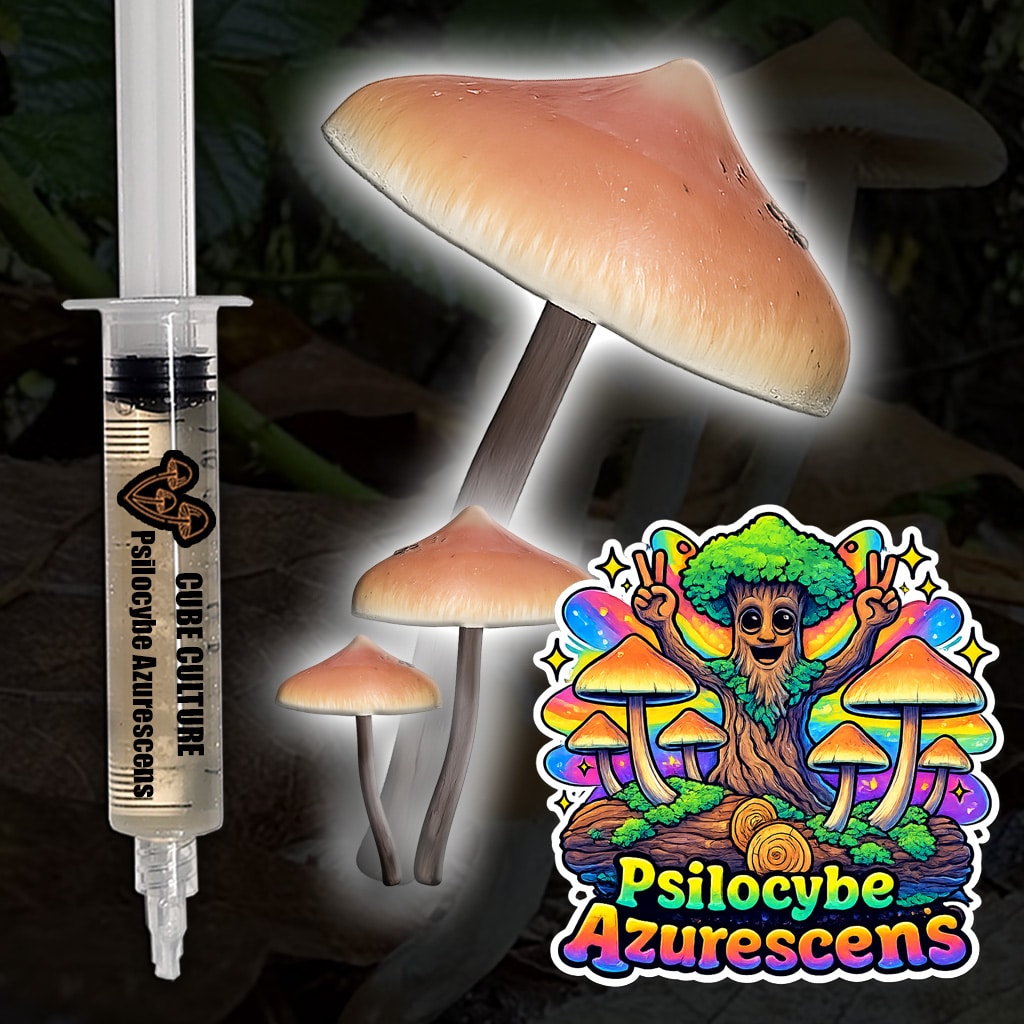

Psilocybe azurescens | Iconic Wood-Loving Pacific Northwest Genetics
A legendary coastal species with unmistakable morphology and exceptional research interest.
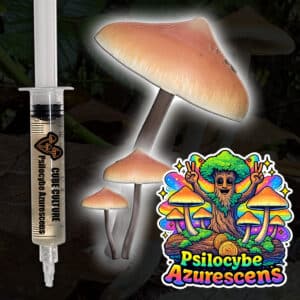
Psilocybe azurescens is one of the most recognizable and heavily discussed wood-loving Psilocybe species in modern mycology. First formally described by Paul Stamets & Jochen Gartz in 1995, this species is known for its pronounced umbo, strong blue bruising response, dense rhizomorphic growth, and close association with lignicolous habitats along the Pacific Northwest coast. Among researchers, P. azurescens is especially valued for its distinct morphology, well-documented habitat profile, and unusually high alkaloid concentrations reported in the literature.
Genetic Lineage & Historical Context
- Species: Psilocybe azurescens
- Authority: Stamets & Gartz (1995)
- Lineage status: Distinct wood-loving Psilocybe species rather than a cubensis variety
- Region of origin: Pacific Northwest coastal corridor, especially around the Columbia River delta and adjoining coastal habitats
- Common names: Flying Saucer, Blue Angel, Azure Psilocybe mushroom
P. azurescens occupies a unique place in fungal literature because it combines visually distinctive macro-morphology with a tightly associated ecological niche. It is commonly referenced alongside other wood-loving blueing species such as P. cyanescens and P. allenii, but remains a distinct taxon with its own characteristic field profile.
Visual Characteristics (Macro Morphology)
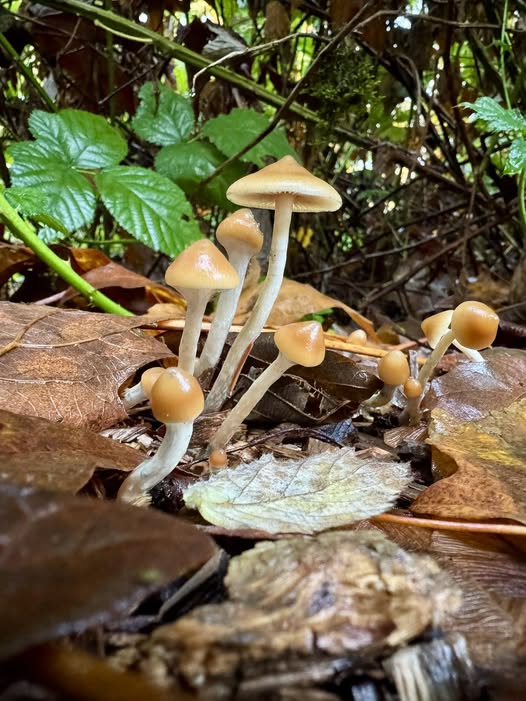
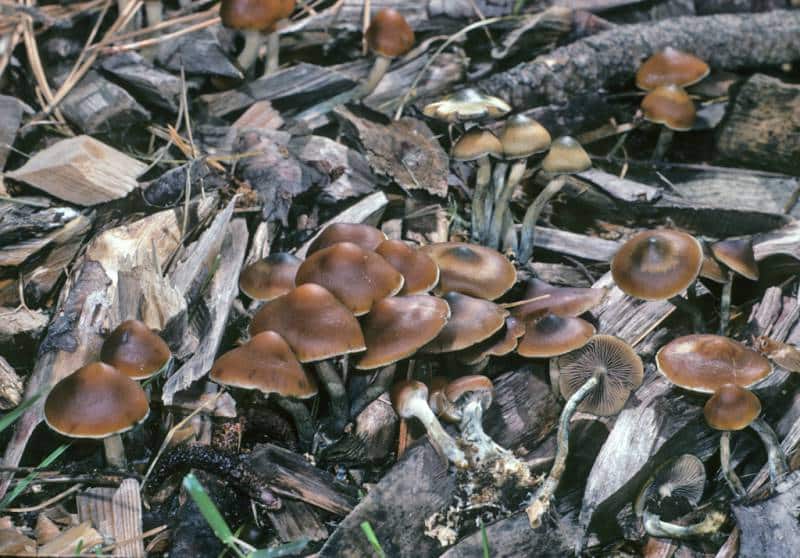
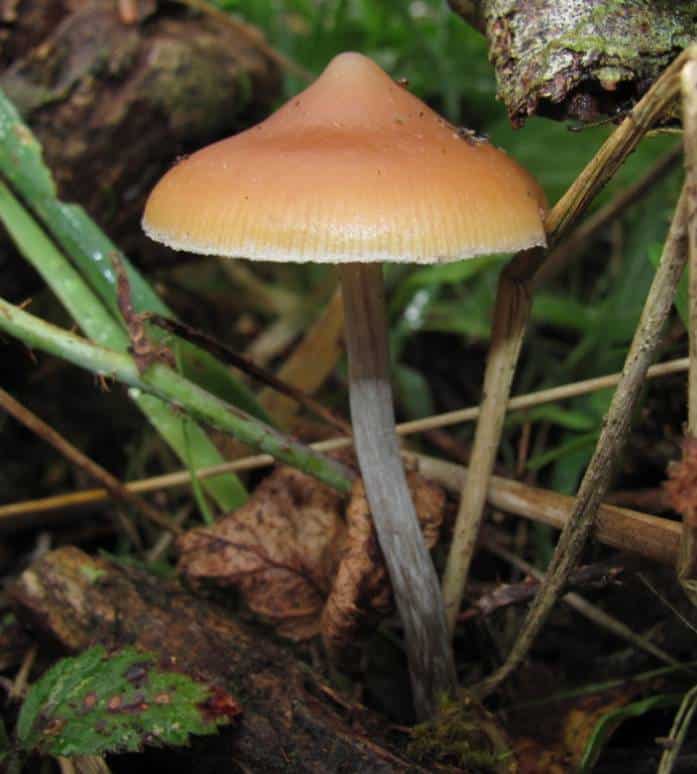
- Cap coloration: Chestnut-brown to ochraceous brown to caramel, fading lighter as it dries
- Cap shape: Conic to convex when young, expanding with maturity while usually retaining a broad, pronounced umbo
- Cap texture: Smooth and viscid when moist, with a separable gelatinous pellicle
- Margin: Often slightly incurved when young, later decurved; translucent striations may appear in moist specimens
- Stem: Long, fibrous, silky white to dingy brown with age, often curved and thickened toward the base
- Base: Frequently shows dense white rhizomorphic mycelium and azure-toned bruising near attached woody material
- Bruising: Strong blue oxidation upon handling or tissue damage
Microscopy & Taxonomy Notes
- Family: Hymenogastraceae
- Order: Agaricales
- Gill attachment: Sinuate to adnate
- Gill color: Brown with whitish edges, darkening with maturity and injury
- Spore print color: Dark purplish-brown to purplish black
- Ecology: Saprotrophic, with a pronounced affinity for woody debris and lignicolous substrates
- Why researchers value it: Its stable habitat association, recognizable cap architecture, and well-documented blueing response make it highly useful for comparative taxonomy and species-level study
Habitat & Distribution Notes
- Native range: A relatively narrow natural range on the U.S. West Coast
- Core geography: Oregon and Washington coastal zones, with historic collections centered near Astoria/Hammond and the Columbia River delta
- Typical substrate association: Deciduous wood chips, woody debris, and sandy soils enriched with lignicolous material
- Field pattern: Often gregarious to clustered, frequently forming dense mycelial mats that bind surrounding woody substrate
- Habitat signature: Noted for association with coastal dune grasses and human-altered woody landscapes
This species is widely recognized as a classic wood-lover and is studied in part because its ecological profile differs so clearly from dung-loving species such as P. cubensis.
Research Notes (Educational Context)
Educational and descriptive context only.
- Analytical significance: Often cited in mycological literature as one of the most chemically notable Psilocybe species
- Reported alkaloid profile: Literature commonly references strong psilocybin expression with measurable psilocin and baeocystin
- Reported potency profile: Frequently described as very high relative to many other commonly discussed Psilocybe species
- Comparative relevance: Important for comparing wood-loving species against grassland and dung-associated taxa
- Modern scientific relevance: Included in recent genomic work expanding taxonomic and metabolic study of the genus Psilocybe
Growth Behavior (High-Level Overview)
- General reputation: Specialized wood-loving species with more niche environmental preferences than standard cubensis lines
- Mycelial character: Known for robust rhizomorphic growth and strong colonization of woody material in descriptive field literature
- Research appeal: Especially attractive to collectors and taxonomic researchers interested in non-cubensis species diversity
- Observation value: Distinct habitat behavior and morphology make it a standout addition to comparative species libraries
For safety and compliance, this section is intentionally limited to broad descriptive observations and excludes instructions, parameters, or cultivation techniques.
Collector & Researcher Highlights
- Species distinction: A true species-level offering, not simply another branded cubensis phenotype
- Habitat specialization: One of the most recognized wood-loving Pacific Northwest taxa in modern mushroom literature
- Morphological identity: Broad umbo, caramel cap tones, intense bruising, and aggressive rhizomorphic base growth
- Abbreviation: Commonly referred to as Azurescens or P. azurescens
Why liquid culture over spores (for research):
- Established genetics: derived from a documented and widely recognized species profile
- Cleaner observation: minimal extraneous material for microscopy prep – Made in front of a scanned, 99.99% efficient HEPA filter
- Species-specific study value: ideal for researchers expanding beyond standard cubensis references
- Shelf Life: Use within 2 months for best results; 70-day viability guarantee when stored properly; may remain viable up to 12 months refrigerated (not guaranteed). DO NOT FREEZE.
Shipping: Fast and Free USPS shipping including all territories including Puerto Rico, U.S. Virgin Islands, Guam, Northern Mariana Islands, and American Samoa. Expedited USPS Priority options available. Products shipped daily (see our Shipping FAQ page for shipping times and questions) No cheap culture and outrageous shipping cost. What you see is what you pay.
- Satisfaction guarantee on all orders
- Military & First Responder discount available
- Shroomery verified & trusted vendor with 100,000+ cultures shipped
- See what our customers say about us!
- All payment methods are accepted, including cash, money order, debit, credit, cryptocurrency at checkout, Cash App, and Venmo.
Important: Products are strictly intended for microscopy and taxonomy research only. Do not use where prohibited by law. None of our products contain any illegal or active alkaloids at the time of shipment.
Add Psilocybe azurescens to your genetic library and explore one of the most distinctive wood-loving species in modern mycological research.
Other Species & Comparison Lines We Carry
Azurescens is a separate species, so its natural companions are the other non-cubensis species in the library, plus the cubensis lines it is most often measured against:
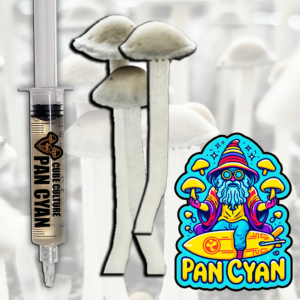
- Hawaiian Panaeolus cyanescens (Pan Cyan) – a psilocybin species from an entirely different genus, and the clearest contrast in spore color, spore shape and habitat
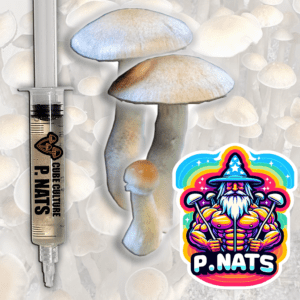
- P. ochraceocentrata (Natal) – another non-cubensis Psilocybe, from African grassland rather than Pacific Northwest wood
- B+ (B Positive) – the cubensis line once claimed to be an azurescens hybrid; comparing the two side by side shows why that claim did not hold up
- Golden Teacher – the P. cubensis reference baseline for comparing a dung-loving tropical species with a wood-loving temperate one
Collecting the family? Add the matching Psilocybe Azurescens vinyl sticker – and every order includes a free random sticker regardless.
Frequently Asked Questions
Is Psilocybe azurescens the same as a cubensis strain?
No. P. azurescens is a distinct species, described by Stamets & Gartz in 1995, rather than a cubensis cultivar. It is wood-loving rather than dung-associated and is tied to the Pacific Northwest coast, which makes it a genuinely different taxonomic subject.
How does azurescens differ from cubensis under observation?
Beyond the species-level difference, azurescens is commonly described with a more conical or wavy cap profile than the rounded cubensis form, a distinctly fibrous stem, and very pronounced blue oxidation. Its wood-loving ecology is also reflected throughout the literature describing it.
What is the difference between a liquid culture and a spore syringe?
A spore syringe carries spores suspended in solution. Spores are genetically varied and have to germinate before any mycelium exists, so what develops can differ from sample to sample. A liquid culture contains living mycelium from a single isolated genetic line that has already been grown out, so you are working with a known, consistent expression from the start and there is no germination stage. For microscopy and taxonomy work that means repeatable observation of the same genetics rather than a mixed population. Every culture we prepare is made in front of a scanned, 99.99% efficient HEPA filter.
How long will my liquid culture stay viable, and how should I store it?
We recommend using your culture within 2 months of receipt for best results. When stored properly it is covered by our 70-day viability guarantee, and properly stored cultures can remain viable for up to 12 months, although viability beyond 70 days is not guaranteed. Keep it refrigerated between 33-40°F and never allow it to freeze. Most cultures survive a single freeze-thaw cycle, but repeated freeze-thaw cycles will kill live mycelium.
What happens if my culture arrives contaminated or does not work?
Every batch is verified contamination-free before it ships, and your order is covered by our 70-Day Guarantee. If a culture arrives contaminated or fails to perform within that window, contact us and we will arrange a replacement or refund. Full terms are set out on our Refund & Replacement Policy page.
How was Psilocybe azurescens discovered and named?
The first collections are traced to the Astoria area of Oregon, near the mouth of the Columbia River, around 1979; the popular story credits a group of Boy Scouts camping nearby. Further type collections were made in 1990, and Paul Stamets and Jochen Gartz formally described the species in 1995. Stamets named it after his son Azureus, whose name refers to the azure-blue bruising that psilocybin mushrooms show when damaged.
How is azurescens related to Psilocybe cyanescens and other wood lovers?
It belongs to a group of closely related wood-loving Psilocybe species that includes P. cyanescens, the wavy cap, and P. subaeruginosa of Australia. The Pacific coast also hosts P. allenii, described in 2012 and named for ethnomycologist John W. Allen. Azurescens is distinguished by its larger size, its broad persistent umbo, its late-season fruiting and its very rapid, intense bruising to indigo-black.
What do azurescens spores look like under the microscope?
Typical of Psilocybe but slightly narrower than cubensis. Stamets’s description gives spores of 12 to 13.5 by 6.5 to 8 micrometers, elliptical, with a germ pore, rich reddish brown in KOH. The gills carry abundant fusoid-ventricose pleurocystidia with a short, bluntly papillate neck, and the cheilocystidia are nearly identical to them.
Have a question we have not covered here? See our full FAQ page.
Additional Information & Research Resources
Documented Origin & Disputed History
Azurescens has a firmer history than most psilocybin mushrooms because it has a formal type description, but its discovery story still carries some lore. The account most often repeated holds that around 1979 a group of Boy Scouts camping near Astoria, Oregon, at the mouth of the Columbia River, came across unusual mushrooms growing in the sandy soil around their campsite. The original clone later used for study has been documented as collected in the Astoria area in October 1979. Primary documentation of the Boy Scout story is hard to find, and it is best read as widely accepted history rather than confirmed fact.
What is documented is the science that followed. Additional collections were made in the Astoria and Tillamook areas in October 1990, with the first type collections recorded from Hammond, Oregon. Paul Stamets and the German mycologist Jochen Gartz formally described the species in 1995 in Integration: Journal for Mind-Moving Plants and Culture. Stamets named it after his son Azureus, himself named for the azure color that psilocybin mushrooms show when bruised. The species reached a much wider audience through Stamets’s 1996 book Psilocybin Mushrooms of the World.
A Late-Season Specialist
Part of the reason azurescens went unnoticed for so long is timing. It fruits from late September into December and sometimes January, in cold, wet conditions that end the season for most related species. It also has a narrow natural range centered on the Columbia River delta, with collections on both the Oregon and Washington sides, often in woody debris among coastal dune grasses. Few collectors were looking in the right place at the right time of year.
What the Peer-Reviewed Genetics Show
Azurescens belongs to the core of the genus Psilocybe, and recent genome work has transformed what is known about that group. In 2024 Bradshaw and colleagues published the largest phylogenomic study of the genus to date in PNAS, using 71 genomes from fungarium specimens, 23 of them from type collections, and nearly 3,000 genes. They concluded that psilocybin production arose in Psilocybe roughly 67 million years ago, near the mass extinction that ended the age of dinosaurs, and later spread to several other mushroom genera by horizontal gene transfer. They also found two different arrangements of the psilocybin gene cluster, matching a deep split in the genus.
In plain language: azurescens and cubensis both belong to the lineage where psilocybin production began, but they have been on separate evolutionary paths for a very long time. The difference between a wood-loving Pacific Northwest species and a dung-loving tropical one is far deeper than the difference between any two cubensis strains.
What Analytical Testing Shows
Azurescens is widely described as the most potent Psilocybe species known. Figures reported by Stamets give up to about 1.8% psilocybin, 0.5% psilocin and 0.4% baeocystin by dry weight, with averages closer to 1.1% psilocybin and 0.15% psilocin. For context, psilocybin across the 14 cubensis strains in a 2026 controlled study in the Journal of Fungi ranged from about 0.2% to 2.0%, so the strongest cubensis lines can reach similar peaks; the reported azurescens average of about 1.1% psilocybin, however, sits well above the middle of that range. As with any species, alkaloid levels vary widely with genetics, habitat, handling and storage, and the highest figures should be read as upper limits rather than typical values.
Microscopy Reference Data
- Spore dimensions: 12–13.5 x 6.5–8 micrometers (Stamets)
- Shape: elliptical in face view, smooth, with a germ pore
- Pigmentation: rich reddish brown in KOH and light purplish vinaceous in ammonia; prints dark purplish-brown to purplish-black
- Pleurocystidia: abundant, fusoid-ventricose, tapering to a short, bluntly papillate neck, roughly 23–35 x 9–10 micrometers
- Cheilocystidia: forming a sterile band on the gill edge, nearly identical to the pleurocystidia, roughly 23–28 x 6.5–8 micrometers
- Other features: four-spored basidia; abundant caulocystidia above the ring zone; abundant clamp connections; tissue noted for strong bluish tones
- Macro reference: cap about 3–10 cm with a broad, persistent umbo; stem about 9–20 cm long and 3–6 mm thick, silky white, often with dense white rhizomorphs at the base; gills brown with whitish edges
- Suggested workflow: 400x for spore shape and cystidia in a gill squash mount, 1000x oil immersion for spore measurement, germ pore detail and clamp connections; compare directly with a cubensis slide to see the narrower spore profile
Azurescens on Video
Background viewing from third-party creators. Species-focused coverage first, then its closest relatives and wider context:
- Azurescens: Through a Blue Lens (Full Film) – Hamilton’s Mushrooms, 31 min. A 2024 documentary on the species and the people who search for it on the Pacific Northwest coast.
- Flying Saucer Mushrooms – DoubleBlind, 8 min. A focused overview of azurescens, its identification, habitat and history.
- Paul Stamets: Psilocybin Mushrooms and the Mycology of Consciousness – MAPS, 33 min. A talk from the mycologist who formally described and named the species.
- Wavy Cap Mushrooms – DoubleBlind, 5 min. An introduction to P. cyanescens, the wood-loving species most often compared with azurescens.
- Australia’s Native Mushroom: Psilocybe subaeruginosa – DoubleBlind, 14 min. Another close wood-loving relative, useful for seeing how the group varies around the world.
- Fungal Microscopy: How to Mount a Slide, View and Measure Spores – Oregon Mycological Society, 5 min. Not species-specific, but the technique you need to measure spores and see cystidia yourself.
These are third-party videos. We are not affiliated with any of these creators and do not control their content. Links are provided for historical and educational context only.
Important Notice:
Once home, cultures should be kept in a fridge between 33-40°F to maximize their lifespan. We recommend using them within 2 months. Viability is guaranteed for 70 days when stored properly, and properly stored cultures can last up to 12 months, but this is not guaranteed.
Do not let your cultures freeze! While most will survive one freeze-thaw cycle, multiple freeze-thaw cycles will kill any live mycelium.
This product description is provided strictly for educational, historical, and scientific context. Products are intended for microscopy and taxonomy research only. Not for cultivation or consumption.
We are not able to offer any cultivation or growing information or advice. Any such requests will be ignored.
Please comply with all applicable local, state, and federal laws.



Reviews
There are no reviews yet.