


Hillbilly Pumpkin | Bulbous “Pumpkin” P. cubensis Isolation
A modern Hillbilly-derived phenotype built for unforgettable morphology study.
Hillbilly Pumpkin is a distinctive Psilocybe cubensis isolation derived from the classic Arkansas “Hillbilly” line, selected for its signature short, thick, pumpkin-like proportions—often presenting stout stems and rounded, bulbous caps that can look “squashed” or “gourd-like” compared to more symmetrical cubensis varieties.
Genetic Lineage & Historical Context
- Species: Psilocybe cubensis
- Parent lineage: Hillbilly (widely described as originating from Arkansas and circulated through early online mycology communities)
- Isolation notes: Hillbilly Pumpkin is commonly described as a clone/isolation of Hillbilly refined by Basidium Equilibrium, emphasizing a bulbous “pumpkin” phenotype
- Lineage status: Modern isolation / phenotype-forward selection
Because Hillbilly Pumpkin is an isolation of an already popular cubensis line, it’s often discussed in the context of speed, consistency, and standout macro traits—making it especially interesting for comparative morphology and phenotype documentation.
Visual Characteristics (Macro Morphology)
- Overall form: Frequently squat and stout; “pumpkin” or “softball” proportions are commonly reported
- Cap shape: Rounded to convex, often appearing thick and bulbous; may look compressed compared to classic tall-fruiting cubes
- Cap coloration: Often orange-tan to caramel hues (can vary with phenotype and maturity)
- Stem: Thick, dense-looking stipe; commonly short-to-medium height relative to cap mass
- Veil remnants: Partial veil may leave annular remnants typical of P. cubensis
- Bruising: Blue oxidation upon handling or damage (typical of psilocybin-containing species)
Microscopy & Taxonomy Notes
- Spore print color: Dark purplish-brown (typical of P. cubensis)
- Gill structure: Crowded gills; attachment and spacing typical of P. cubensis (use standard cubensis ID references)
- What researchers like to document: The contrast between classic cubensis “tall & symmetrical” forms versus Hillbilly Pumpkin’s compact, bulbous phenotype
Research Notes (Educational Context)
Educational and descriptive context only.
- Potency (reported): Medium to high (reports vary widely; community anecdotes frequently describe it as “surprisingly strong”)
- Why it’s discussed: The Hillbilly family of genetics has received broader attention in modern community “cup” style events and strain writeups, helping push Hillbilly-derived lines into the mainstream conversation
- Analytical relevance: A useful specimen when comparing phenotype-forward selections (shape/size expression) within the same species framework
Cultivation Characteristics (High-Level Overview)
- Difficulty: Beginner-friendly / resilient genetics (as commonly described for Hillbilly-derived lines)
- Growth behavior: Frequently reported as fast and consistent compared to many cubensis varieties
- Why it’s notable: Eye-catching morphology that tends to photograph well and document clearly for phenotype study
For safety and compliance, this section is descriptive only and excludes instructions, parameters, or cultivation techniques.
Collector & Researcher Highlights
- Standout phenotype: Bulbous, “pumpkin-like” stems & caps are the signature trait
- Hillbilly-derived: Built on a widely circulated Arkansas cubensis line
- Abbreviation: Commonly referred to as HBP (Hillbilly Pumpkin)
Why liquid culture over spores (for research):
- Established genetics: derived from a stable isolation selected for repeatable phenotype observation
- Cleaner observation: minimal extraneous material for microscopy prep – Made in front of a scanned, 99.99% efficient HEPA filter
- Reliable morphology focus: ideal for repeated comparative study of “pumpkin” traits
- Shelf Life: Use within 2 months for best results; 70-day viability guarantee when stored properly; may remain viable up to 12 months refrigerated (not guaranteed). DO NOT FREEZE.
Shipping: Fast and Free USPS shipping including all territories including Puerto Rico, U.S. Virgin Islands, Guam, Northern Mariana Islands, and American Samoa. Expedited USPS Priority options available. Products shipped daily (see our Shipping FAQ page for shipping times and questions) No cheap culture and outrageous shipping cost. What you see is what you pay.
- Satisfaction guarantee on all orders
- Military & First Responder discount available
- Shroomery verified & trusted vendor with 100,000+ cultures shipped
- See what our customers say about us!
- All payment methods are accepted, including cash, money order, debit, credit, cryptocurrency at checkout, Cash App, and Venmo.
Important: Products are strictly intended for microscopy and taxonomy research only. Do not use where prohibited by law. None of our products contain any illegal or active alkaloids at the time of shipment.
Add Hillbilly Pumpkin to your genetic library and document one of the most visually distinctive Hillbilly-derived P. cubensis phenotypes in circulation.
Hillbilly Family & Companion Lines We Carry
Hillbilly Pumpkin is a selection from a larger Hillbilly population, so its parent line is the natural first comparison. These sit well beside it in a comparative library:
- Hillbilly – the parent line, and the clearest way to see exactly which traits the Pumpkin selection exaggerates
- Purple Mystic – another wild-found line from the American South, useful for comparing two regional finds
- Golden Teacher – the species reference baseline for classic proportions, and the best contrast to a squat, bulbous body type
- B+ (B Positive) – a tall, broad-capped classic at the opposite end of the build spectrum
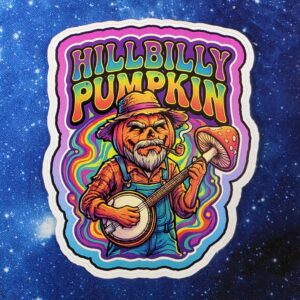
Collecting the family? Add the matching Hillbilly Pumpkin vinyl sticker – and every order includes a free random sticker regardless.
Frequently Asked Questions
What is Hillbilly Pumpkin isolated from?
Hillbilly Pumpkin is an isolation from the classic Arkansas Hillbilly line, commonly credited to Basidium Equilibrium. It was selected specifically for its bulbous “pumpkin” phenotype.
Why is it called Pumpkin?
The name refers to its short, stout, heavily rounded proportions — thick stems with compressed, bulbous caps that collectors compare to a pumpkin or a softball. It is the most visually distinctive trait of the line.
What is the difference between a liquid culture and a spore syringe?
A spore syringe carries spores suspended in solution. Spores are genetically varied and have to germinate before any mycelium exists, so what develops can differ from sample to sample. A liquid culture contains living mycelium from a single isolated genetic line that has already been grown out, so you are working with a known, consistent expression from the start and there is no germination stage. For microscopy and taxonomy work that means repeatable observation of the same genetics rather than a mixed population. Every culture we prepare is made in front of a scanned, 99.99% efficient HEPA filter.
How long will my liquid culture stay viable, and how should I store it?
We recommend using your culture within 2 months of receipt for best results. When stored properly it is covered by our 70-day viability guarantee, and properly stored cultures can remain viable for up to 12 months, although viability beyond 70 days is not guaranteed. Keep it refrigerated between 33-40°F and never allow it to freeze. Most cultures survive a single freeze-thaw cycle, but repeated freeze-thaw cycles will kill live mycelium.
What happens if my culture arrives contaminated or does not work?
Every batch is verified contamination-free before it ships, and your order is covered by our 70-Day Guarantee. If a culture arrives contaminated or fails to perform within that window, contact us and we will arrange a replacement or refund. Full terms are set out on our Refund & Replacement Policy page.
Where does the Hillbilly line come from?
Hillbilly is generally traced to a forager posting as Hillbilly on the Mycotopia forum, who is said to have collected it in Arkansas in the late 1990s or early 2000s. From there it spread through hobbyist communities and has since been used as a parent in several newer crosses.
How is Hillbilly Pumpkin different from standard Hillbilly?
Hillbilly is known to express at least two forms: a stocky, chunky phenotype and a taller one with a wider canopy. Hillbilly Pumpkin is an isolation that locks in the stocky extreme, with short, thick stems and heavily rounded caps. Keeping it as an isolated culture preserves that one form rather than the mix a spore population can produce.
What do Hillbilly Pumpkin spores look like under the microscope?
Typical of the species: smooth, subellipsoid, dark purple-brown in transmitted light, with a germ pore, and roughly 11 to 17 micrometers long by 7 to 12 wide. The Hillbilly family is described as releasing relatively few spores from its compact caps, so collections can be lighter than from tall, fully opening lines, though spores can still be recovered from the gills.
Have a question we have not covered here? See our full FAQ page.
Additional Information & Research Resources
Documented Origin & Disputed History
Hillbilly Pumpkin has two layers of history: the wild find behind the Hillbilly line, and the selection work that produced the Pumpkin isolation. The parent line is generally traced to a forager posting as Hillbilly on the Mycotopia forum, who is said to have collected it in Arkansas sometime in the late 1990s or early 2000s. It spread from there through hobbyist communities and has become one of the better-known American wild-found lines, later serving as a parent for crosses such as Black Pearl and Country Cock.
Hillbilly is known to express more than one form, and the Pumpkin line is a selection taken from its stocky extreme. It is commonly credited to a spore and genetics outfit that isolated and refined the bulbous phenotype. Neither the original Arkansas collection nor the isolation work is formally documented, so we present both accounts as the community records them.
Why Selection Matters for a Line Like This
Named cubensis lines are rarely genetically uniform. A spore population from Hillbilly can produce both its compact and its taller forms, because it carries a mix of genotypes. Isolating one clone freezes a single genotype, which is how a trait like the Pumpkin body shape can be kept consistent from culture to culture. Population genomics supports that picture of how cultivars are built: McTaggart and colleagues, writing in Current Biology in 2023, found cultivated P. cubensis lines to be closely related and low in genetic diversity, with strong signs of clonal propagation. Selections like Pumpkin are part of that process.
In plain language: Hillbilly Pumpkin is less a new genetic line than a single, stable snapshot of one end of Hillbilly’s natural range. That makes it especially useful beside the parent line for documenting how much shape can vary within one strain name.
What Analytical Testing Shows
There is no published data on Hillbilly Pumpkin itself, but the parent line has been tested more than most. In coverage by DoubleBlind, independent lab testing of Hillbilly samples was reported in a range of about 4 to 13 mg/g total tryptamines, averaging around 7 mg/g, and a Hillbilly entry won the microdose category of the Spring 2022 Hyphae Cup at 4.93 mg/g. For context, a 2026 peer-reviewed study in the Journal of Fungi by Sharchaton and colleagues grew 14 cubensis strains under identical conditions and found totals from 2.62 to 20.65 mg/g, with individual fruiting bodies within one strain varying by 12.8 to 23.4 percent in psilocybin. Hillbilly sits in the middle of that range.
Microscopy Reference Data
- Spore dimensions: within the normal P. cubensis range of roughly 11–17 x 7–12 micrometers; published Hillbilly Pumpkin-specific measurements are not available
- Shape: subellipsoid, smooth-walled, no surface ornamentation
- Germ pore: truncate at the apical end, resolvable at 1000x oil immersion
- Pigmentation: dark purple-brown under transmitted light; prints may be lighter than from tall, fully opening lines
- Macro reference: squat, stout fruiting bodies; short, thick stems; heavily rounded, bulbous caps in orange-tan to caramel tones; blue bruising where handled
- Suggested workflow: 100x to confirm coverage, 400x for primary morphological observation, 1000x oil immersion for measurement and germ pore detail; photograph beside Hillbilly at matching stages to document the shape difference
Hillbilly Pumpkin on Video
Background viewing from third-party creators. Pumpkin-specific footage is scarce, so coverage of the parent line comes first, then wider context and technique:
- Hillbilly Mushrooms: What Are They? – DoubleBlind, 13 min. The most thorough overview of the parent line, covering its Arkansas origin, its two phenotypes and its reputation.
- The Wild Science Behind Mushroom Strains – North Spore, 9 min. Explains what a strain designation does and does not mean, which matters for a selection taken from within a named line.
- Golden Teacher Mushrooms: What Are They? – DoubleBlind, 21 min. The reference line for classic cubensis proportions, useful as a contrast to Pumpkin’s squat build.
- The 5 Most Popular Psilocybin Mushroom Strains – Third Wave, 7 min. Context on the best-known cubensis varieties that the Hillbilly family is usually compared with.
- Fungal Microscopy: How to Mount a Slide, View and Measure Spores – Oregon Mycological Society, 5 min. Not strain-specific, but the most useful video here if you are doing the measurement work yourself.
These are third-party videos. We are not affiliated with any of these creators and do not control their content. Links are provided for historical and educational context only.
Important Notice:
Once home, cubensis cultures should be kept in a fridge between 33-40°F to maximize their lifespan. We recommend using them within 2 months. Viability is guaranteed for 70 days when stored properly, and properly stored cultures can last up to 12 months, but this is not guaranteed.
Do not let your cultures freeze! While most will survive one freeze-thaw cycle, multiple freeze-thaw cycles will kill any live mycelium.
This product description is provided strictly for educational, historical, and scientific context. Products are intended for microscopy and taxonomy research only. Not for cultivation or consumption.
We are not able to offer any cultivation or growing information or advice. Any such requests will be ignored.
Please comply with all applicable local, state, and federal laws.



David B. (verified owner) –
Xavier (verified owner) –
Ryan H. (verified owner) –
Yall rock and the veteran discount is top notch and I’ve bought multiple products and every single one has been clean and viable period if you need legit culture cube culture has you covered
Christopher (verified owner) –
Amazing people very fast delivery and the only people I use since I’ve found them
Anonymous (verified owner) –
Ryan (verified owner) –