

Hawaiian Panaeolus cyanescens | “Copelandia” Pan Cyan Genetics
A legendary tropical dung-loving species prized for microscopy, taxonomy, and comparative alkaloid research.
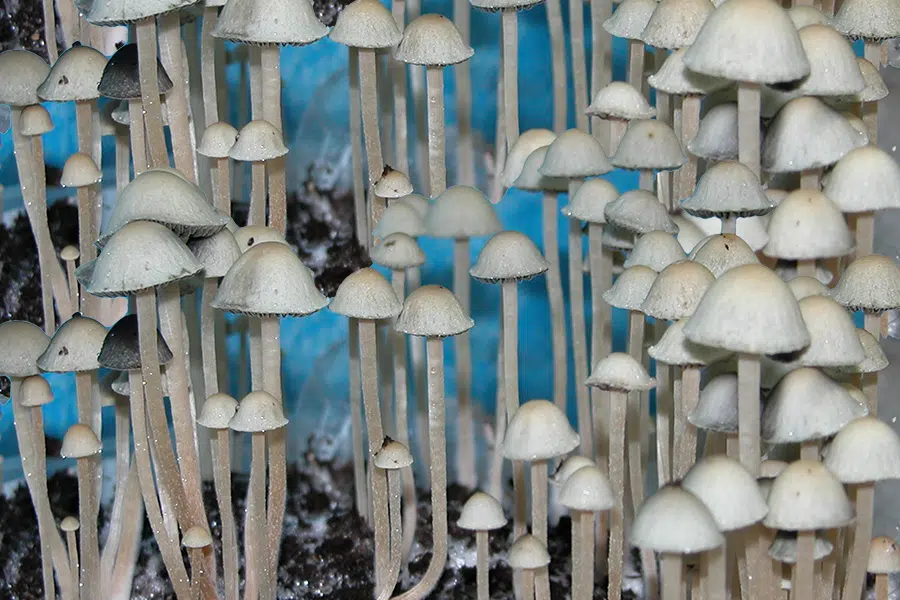
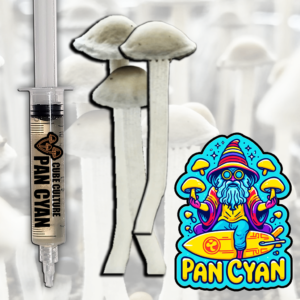
Panaeolus cyanescens (often called “Hawaiian Copelandia,” “Pan Cyans,” or “blue-staining Panaeolus”) is a small, delicate, jet‑spored mushroom species recognized for its mottled gills and intense blue bruising. Unlike Psilocybe cubensis, this species belongs to the genus Panaeolus (family Bolbitiaceae) and is frequently referenced in both modern field guides and older literature under the genus name Copelandia.
Genetic Lineage & Historical Context
- Species: Panaeolus cyanescens (Sacc.)
- Common/legacy names: “Hawaiian Copelandia,” “Copelandia cyanescens,” “Pan Cyan,” “Blue Meanies”
- Taxonomic note: Widely treated as Panaeolus cyanescens today; many older resources list it as Copelandia cyanescens
- Original basionym: Agaricus cyanescens (1871); later recombined as Panaeolus cyanescens (1887)
The “Hawaiian” designation typically refers to island‑associated collections/isolates in circulation, but P. cyanescens is broadly distributed across tropical and subtropical regions worldwide.
Visual Characteristics (Macro Morphology)
- Cap size: Small, commonly ~1.5–4 cm across
- Cap color: Light brown when young, often fading to off‑white / pale gray with age; may crack in dry conditions
- Cap shape: Hemispheric to convex/campanulate; margin often incurved when young
- Gills: Gray to black at maturity, typically mottled (a hallmark of many Panaeolus)
- Stem: Slender, pale to cap‑colored, often pruinose; can stain blue where handled
- Bruising: Blue‑green oxidation can appear on cap/stem where damaged
Microscopy & Taxonomy Notes
- Spore print color: Black
- Spore morphology (typical reports): Dark/jet‑black, smooth, elliptic; commonly reported around ~12–15 × 7–11 µm with an apical germ pore
- Gill structure: Adnate to adnexed attachment; faces frequently show the classic “panaeoloid” mottling pattern
- Why Pan Cyans are studied: Clear genus‑level traits (mottled gills + dark spores) make them useful for taxonomy training and comparative microscopic observation
Distribution & Ecology (Field Context)
- Ecology: Saprotrophic; strongly coprophilous (often associated with herbivore dung and enriched grasses)
- Climate: Primarily tropical/subtropical; commonly reported in warm, humid regions
- Range: Frequently documented across Oceania, Southeast Asia, the Caribbean, parts of the Americas, and locations including Hawaii
Field ecology is included for identification context only and is not intended as cultivation guidance.
Research Notes (Educational Context)
Educational and descriptive context only.
- Analytical reputation: Commonly described in the literature and modern reporting as a high‑potency psilocybin species relative to many P. cubensis varieties
- Chemistry notes (published research): Modern analytical work has documented meaningful profile differences among psilocybin‑producing species, including samples of P. cyanescens with notably high psilocin levels in some datasets
- Additional compounds: Reports in peer‑reviewed literature note the presence of other constituents such as baeocystin and unusually high urea levels in P. cyanescens
Cultivation Characteristics (High‑Level Overview)
- General difficulty (reported): Often considered more sensitive than P. cubensis in lab handling contexts
- Growth behavior (general): Known for delicate morphology and fast bruising/oxidation compared to many cubensis lines
- Research value: Useful for comparative observation versus common cubensis varieties due to different genus‑level traits (spores, gill mottling, stature)
For safety and compliance, this section is descriptive only and excludes instructions, parameters, or cultivation techniques.
Collector & Researcher Highlights
- Distinct genus traits: Mottled gills + black spore print (classic Panaeolus)
- Legacy naming: “Copelandia” label remains common in historical and community references
- Abbreviation: Commonly referred to as Pan Cyan / P. cyan
Why liquid culture over spores (for research):
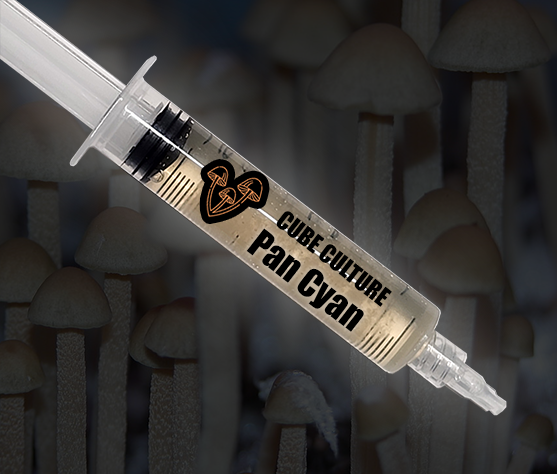
- Established genetics: derived from a stable, documented lineage
- Cleaner observation: minimal extraneous material for microscopy prep – Made in front of a scanned, 99.99% efficient HEPA filter
- Reliable morphology: ideal for repeated comparative study
- Shelf Life: Use within 2 months for best results; 70-day viability guarantee when stored properly; may remain viable up to 12 months refrigerated (not guaranteed). DO NOT FREEZE.
Shipping: Fast and Free USPS shipping including all territories including Puerto Rico, U.S. Virgin Islands, Guam, Northern Mariana Islands, and American Samoa. Expedited USPS Priority options available. Products shipped daily (see our Shipping FAQ page for shipping times and questions) No cheap culture and outrageous shipping cost. What you see is what you pay.
- Satisfaction guarantee on all orders
- Military & First Responder discount available
- Shroomery verified & trusted vendor with 100,000+ cultures shipped
- See what our customers say about us!
- All payment methods are accepted, including cash, money order, debit, credit, cryptocurrency at checkout, Cash App, and Venmo.
Important: Products are strictly intended for microscopy and taxonomy research only. Do not use where prohibited by law. None of our products contain any illegal or active alkaloids at the time of shipment.
Add Hawaiian Panaeolus cyanescens to your genetic library and explore one of the most distinctive tropical Panaeolus species in modern microscopy research.
Other Species & Comparison Lines We Carry
Pan Cyan is one of the few true non-Psilocybe species in a psilocybin-mushroom library, which makes it most useful beside lines that show how different a separate genus really is:
- Blue Meanie (Cubensis) – a P. cubensis line that shares the “Blue Meanie” name, and the clearest way to show why common names are no substitute for spore color and microscopy
- P. ochraceocentrata (Natal) – another non-cubensis species, from African grassland, useful for comparing two separate lineages from open, grassy habitats
- Psilocybe azurescens – a wood-loving species at the opposite ecological extreme, and the best contrast in a library built around habitat
- Golden Teacher – the P. cubensis reference baseline for comparing purple-brown against jet-black prints and very different spore shapes
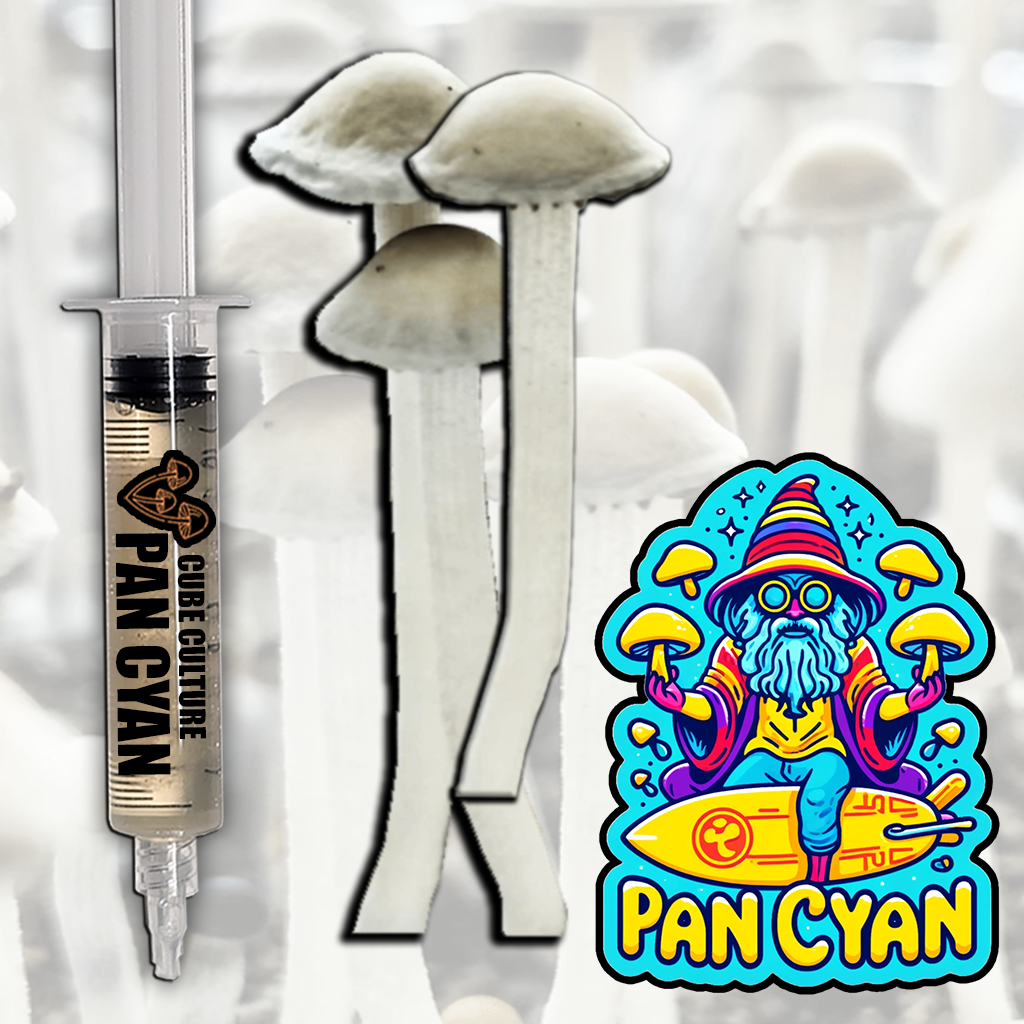
Collecting the family? Add the matching Pan Cyan vinyl sticker – and every order includes a free random sticker regardless.
Frequently Asked Questions
How is Panaeolus cyanescens different from Psilocybe cubensis?
They belong to different genera. P. cyanescens produces a black spore print with mottled gills, while P. cubensis produces a dark purplish-brown print. Pan cyans are also considerably smaller and more delicate, which makes the two straightforward to separate under the scope.
Why is it sometimes called Copelandia?
Older literature and many community sources list the species as Copelandia cyanescens. It is widely treated as Panaeolus cyanescens today, but the legacy Copelandia name remains common in historical references and vendor catalogs.
What is the difference between a liquid culture and a spore syringe?
A spore syringe carries spores suspended in solution. Spores are genetically varied and have to germinate before any mycelium exists, so what develops can differ from sample to sample. A liquid culture contains living mycelium from a single isolated genetic line that has already been grown out, so you are working with a known, consistent expression from the start and there is no germination stage. For microscopy and taxonomy work that means repeatable observation of the same genetics rather than a mixed population. Every culture we prepare is made in front of a scanned, 99.99% efficient HEPA filter.
How long will my liquid culture stay viable, and how should I store it?
We recommend using your culture within 2 months of receipt for best results. When stored properly it is covered by our 70-day viability guarantee, and properly stored cultures can remain viable for up to 12 months, although viability beyond 70 days is not guaranteed. Keep it refrigerated between 33-40°F and never allow it to freeze. Most cultures survive a single freeze-thaw cycle, but repeated freeze-thaw cycles will kill live mycelium.
What happens if my culture arrives contaminated or does not work?
Every batch is verified contamination-free before it ships, and your order is covered by our 70-Day Guarantee. If a culture arrives contaminated or fails to perform within that window, contact us and we will arrange a replacement or refund. Full terms are set out on our Refund & Replacement Policy page.
Is a Pan Cyan the same as a Blue Meanie?
It depends who is using the name. In Australia, Blue Meanie is a long-standing common name for Panaeolus cyanescens itself. Elsewhere, Blue Meanie is also the name of a Psilocybe cubensis line. The two are different genera: Pan Cyans drop a jet-black print with lemon-shaped spores, while cubensis drops a purple-brown print with subellipsoid spores. A spore print or a slide settles the question immediately.
How does a Panaeolus make psilocybin?
It appears to have acquired the ability rather than inheriting it from a shared ancestor with Psilocybe. Genome sequencing of Panaeolus cyanescens found the same psilocybin gene cluster used by Psilocybe, along with evidence that the cluster moved between unrelated mushroom lineages by horizontal gene transfer. Later phylogenomic work dated the origin of psilocybin production within Psilocybe to roughly 67 million years ago, with several later transfers to other mushrooms.
What do Pan Cyan spores look like under the microscope?
Very different from cubensis. Pan Cyan spores are lemon-shaped (limoniform) in face view and ellipsoid in side view, thick-walled and nearly opaque black, with a truncate germ pore at one end. A 2018 study of Brazilian collections measured them at 11.5 to 14.5 by 9 to 11 micrometers. The gills also carry large, thick-walled pleurocystidia with crystal-encrusted tips, a feature that separates the old Copelandia group from other Panaeolus.
Have a question we have not covered here? See our full FAQ page.
Additional Information & Research Resources
Taxonomic History: From Agaricus to Copelandia to Panaeolus
Pan Cyan has one of the longest paper trails of any species we carry. It was first described in 1871 by Miles Berkeley and Christopher Broome as Agaricus cyanescens, in their work on the fungi of Ceylon (now Sri Lanka). Pier Andrea Saccardo moved it to Panaeolus in 1887. In 1912 the Italian mycologist Giacomo Bresadola set up Copelandia for the blue-staining Panaeolus species with distinctive thick-walled cystidia, naming it for Edwin Bingham Copeland, an American botanist who collected fungi in the Philippines.
Whether Copelandia deserves to be a genus of its own has been argued ever since. Many mycologists now treat it as part of Panaeolus, while others, including some recent regional studies, still keep it separate on the strength of its cystidia. That is why the same mushroom appears in the literature as Panaeolus cyanescens, Copelandia cyanescens and Agaricus cyanescens. All three names refer to the same species.
The Hawaiian Connection
The “Hawaiian” label comes from the islands’ long association with the species. Steven Pollock published a case study from Hawaii in the Journal of Psychedelic Drugs in 1974, one of the first modern accounts of the species in the islands. In 1993 Mark Merlin and John W. Allen published a survey of psychoactive fungi in the Hawaiian Islands in the Journal of Ethnopharmacology, identifying Copelandia species and analyzing their chemistry. Hawaiian isolates became some of the best-known Pan Cyan genetics in circulation, although the species itself is pantropical and occurs across Asia, Africa, Oceania and the Americas.
What the Peer-Reviewed Genetics Show
Pan Cyan sits at the center of one of the most interesting findings in psilocybin research. Reynolds and colleagues, writing in Evolution Letters in 2018, sequenced the genomes of three distantly related psilocybin mushrooms: Psilocybe cyanescens, Panaeolus (Copelandia) cyanescens and Gymnopilus dilepis. They found the same psilocybin gene cluster in all three and evidence that it had moved between fungal lineages by horizontal gene transfer. They proposed that psilocybin gives an advantage in the dung and late wood-decay niches, where these mushrooms live alongside insects and other competitors.
A larger 2024 phylogenomic study in PNAS by Bradshaw and colleagues built on this. It dated the origin of psilocybin production within Psilocybe to roughly 67 million years ago, near the mass extinction that ended the age of dinosaurs, and identified four to five possible later transfers to other mushrooms between about 40 and 9 million years ago.
In plain language: Pan Cyan did not inherit psilocybin from a common ancestor with cubensis. It appears to have borrowed the genes from another lineage. That makes it one of the most useful species available for comparing how the same chemistry works in two unrelated mushrooms.
What Analytical Testing Shows
Pan Cyan has long been reported as unusually strong for its size, and it is also unusual in its balance of compounds. In a 2010 forensic study published in Forensic Science International, Laussmann and Meier-Giebing reported psilocybin around 2.5% and psilocin around 1.2% in the P. cyanescens samples they analyzed. Psilocin at that level is notable: in most Psilocybe species psilocybin dominates and psilocin is present only in small amounts. Serotonin and urea have also been reported from the species. As with any single dataset, values vary with genetics, conditions and handling.
Microscopy Reference Data
- Spore dimensions: 11.5–14.5 x 9–11 micrometers in a 2018 study of Brazilian collections; other references give 12–15 x 7–11
- Shape: limoniform (lemon-shaped) in face view, ellipsoid in side view; thick-walled and smooth
- Germ pore: apical and truncate, easily resolved at 1000x oil immersion
- Pigmentation: opaque jet-black; reddish-brown to black in KOH
- Basidia: four-spored, broadly clavate, roughly 17–22.5 x 9–12.5 micrometers
- Pleurocystidia: abundant thick-walled metuloids, roughly 33.5–68 x 15–25 micrometers, with crystal-encrusted tips, the defining Copelandia feature
- Cheilocystidia: lageniform to pear-shaped, roughly 21–37 x 7–14 micrometers
- Macro reference: cap about 1.5–4 cm, hygrophanous, fading from light brown to pale gray; stem roughly 6–12 cm long and only 2–4 mm thick; mottled gills; strong blue-green bruising
- Suggested workflow: 400x for spore shape in face and side view, 1000x oil immersion for the germ pore and wall thickness; a gill squash mount is the fastest way to see the metuloid pleurocystidia
Pan Cyan on Video
Background viewing from third-party creators. Species-focused coverage first, then identification and technique:
- An Introduction to Panaeolus cyanescens – Caine Barlow for Entheogenesis Australis, 7 min. A mycologist’s overview of the species, its taxonomy and where it is found.
- Blue Meanie Mushrooms – DoubleBlind, 13 min. Covers identification, habitat, the history of the name and look-alikes for P. cyanescens.
- Blue Meanie Mushrooms: Why They Hit Harder – April Pride, 14 min. Explains the two different mushrooms that share the Blue Meanie name and why the Panaeolus is so distinct.
- Panaeolus Identification: 3 Similar Species Compared Side by Side – The Holy Spring Journey, 3 min. A side-by-side look at cap shape, gills, bruising and habitat across three look-alike Panaeolus species.
- Every Psychedelic Mushroom and Its Effects Explained – PathoHub, 24 min. A broad survey of the psilocybin genera, useful for seeing where Panaeolus fits beside Psilocybe.
- Fungal Microscopy: How to Mount a Slide, View and Measure Spores – Oregon Mycological Society, 5 min. Not species-specific, but the technique you need to see limoniform spores and metuloid cystidia for yourself.
These are third-party videos. We are not affiliated with any of these creators and do not control their content. Links are provided for historical and educational context only.
Important Notice:
Once home, cubensis cultures should be kept in a fridge between 33-40°F to maximize their lifespan. We recommend using them within 2 months. Viability is guaranteed for 70 days when stored properly, and properly stored cultures can last up to 12 months, but this is not guaranteed.
Do not let your cultures freeze! While most will survive one freeze-thaw cycle, multiple freeze-thaw cycles will kill any live mycelium.
This product description is provided strictly for educational, historical, and scientific context. Products are intended for microscopy and taxonomy research only. Not for cultivation or consumption.
We are not able to offer any cultivation or growing information or advice. Any such requests will be ignored.
Please comply with all applicable local, state, and federal laws.
Hershell B. –
Awesome!
Kevin C. –
Well i haven't got it yet.
Matthew B. –
Great stuff
James –
Syringes are packed with plenty of culture to study and are very clean! Highly recommend Cube Culture, you will not be disappointed. Their customer service and responses are quick and very helpful!
Cherie c. –
I've ordered from them multiple times & I absolutely will again! Everything has been great!!!
Christopher C. –
But I haven't heard back and I email twice three days apart. It's been a week and still nothing.
Paul P. –
Excellent company, exceeded my expectations. Definitely a customer for life. Not to mention fast shipping.
steve h. –
Indeed. :punch:
great service.
old hippy
BRIAN O. –
Greetings! Thanks for the follow up. I have ben very happy with the dozen or so different strain cultures I have purchased from your company. However, this particular one (Pan Cyan) seems to have a bacterial contaminant. All the jars (6) have failed in the same exact way, while no other strains have shown this particular contamination. It is very distinctive, with droplets forming on the rye berries, and the surrounding berries appearing very wet. I would appreciate a replacement Pan Cyan syringe, if that would be possible. Thank you!
Michael R. (verified owner) –
Nice culture
Joel (verified owner) –
Arrived fast as heck, I’m sure it would have been a great research sample had i managed to not break my syringe lol
Sam M. (verified owner) –
Ahmir Stafford (verified owner) –
stilltwiztid4life (verified owner) –
Crazy fast… And WOW, that is the most active mycelium syringe I have ever ordered… Thanks so much. You guys are awesome. Inoculation complete, growth by the morning garunteed… 😁 ✌️ And 💕 from the 505
Michael S. (verified owner) –
First time with these. All appear to be going fine so far!
Anonymous (verified owner) –
Slower than other strains little picky on environmental settings do the math and it pays off tremendously
Anonymous (verified owner) –
Great genetics! This one can sometimes be a little more picky of a strain but just practice your patience. It’ll tell you when it’s ready. Highly recommend test driving.
Anonymous (verified owner) –
Anthony B. (verified owner) –
Michael W. (verified owner) –
Great product and great service!
Brian Degaugh (verified owner) –
Haven’t received it yet. I live in NY. It was in Atlanta Ga. Now it’s in San Francisco. Seems to be heading in the wrong direction.