


Ghost | True Albino Teacher P. cubensis Genetics
A haunting white TAT-family isolation for advanced microscopy collections.
Ghost is a highly recognizable Psilocybe cubensis variety from the True Albino Teacher (TAT) genetic family. Known for its pale white to ivory coloration, smooth ghostlike caps, dense structure, and dramatic blue oxidation, Ghost has become a standout lineage for microscopy, taxonomy, and comparative genetic observation. Its unusual albino expression makes it especially valuable for researchers interested in pigment loss, recessive trait expression, and the visual diversity possible within modern cubensis genetics.
Genetic Lineage & Historical Context
- Species: Psilocybe cubensis
- Lineage status: True Albino Teacher (TAT) family cubensis isolation
- Parent-family context: Commonly associated with the Albino Golden Teacher / True Albino Teacher genetic branch
- Related varieties: Often discussed alongside other TAT-family isolates such as Yeti and other pale or albino teacher-type genetics
- Community recognition: Ghost gained attention in modern mycology circles for its clean white phenotype, stable albino appearance, and distinctive “spectral” presentation
Ghost is not generally treated as a wild landrace variety. It is best understood as a modern albino cubensis isolation selected from the broader Teacher/TAT genetic family for its unusual coloration and morphology.
Visual Characteristics (Macro Morphology)
- Cap coloration: White, ivory, cream, or very pale gray-white; often described as having a clean “ghost” appearance
- Cap shape: Rounded to convex when young, becoming broader and sometimes slightly wavy or flattened with maturity
- Stem: Pale white to ivory, commonly appearing thick, dense, and sturdy compared with many classic cubensis varieties
- Surface appearance: Smooth, matte to lightly glossy, with minimal golden or caramel pigmentation
- Veil remnants: Partial veil may leave an annular ring or skirt-like remnant depending on maturity
- Bruising: Blue to blue-gray oxidation may appear strongly against the pale tissue when handled or damaged
- Overall phenotype: Pale, spectral, and sculptural; prized for its contrast between white tissue and blue oxidation
Microscopy & Taxonomy Notes
- Taxonomic placement: Psilocybe cubensis, a gilled basidiomycete in the family Hymenogastraceae
- Gill structure: Crowded, with adnate to adnexed attachment typical of P. cubensis
- Spore observation: Albino and TAT-family lines are often discussed for reduced or unusual visible spore pigmentation compared with standard dark-spored cubensis varieties
- Species-level comparison: Standard P. cubensis varieties are typically associated with dark purplish-brown spore deposits, while albino selections may present atypical visual spore characteristics in collector reports
- Research value: Useful for comparing pigmentation, tissue morphology, bruising contrast, and albino trait expression against classic pigmented cubensis lines
Because Ghost belongs to a modern albino/TAT family, visual observations may differ from classic brown-capped cubensis varieties. Microscopy and taxonomy work should focus on species-level traits, morphology, and comparative phenotype rather than appearance alone.
Research Notes (Educational Context)
Educational and descriptive context only.
- Potency (reported): Often reported by anecdotal sources as medium to high; no potency claim should be assumed without qualified laboratory analysis
- Common descriptive language: Collectors often describe Ghost as clean, pale, dense, elegant, otherworldly, and visually dramatic
- Analytical relevance: Frequently referenced in discussions of albino cubensis genetics, TAT-family trait stability, and comparison with other pale isolates
- Phenotype interest: The near-white coloration makes blue oxidation, veil remnants, gill development, and tissue structure easier to visually compare during lawful microscopy and taxonomy study
- Genetic-library value: A strong addition for researchers who already keep classic varieties such as Golden Teacher and want a visually distinct albino/TAT-family comparison point
Cultivation Characteristics (High-Level Overview)
- Difficulty: Generally described as more advanced than beginner-friendly classic cubensis varieties
- Growth behavior: Known in community reports for distinctive albino expression and dense morphology rather than maximum speed
- Stability: Valued for recognizable pale traits when maintained as an isolated research culture
- Environmental tolerance: Best described as a specialized modern isolation rather than a rugged landrace-type variety
For safety and compliance, this section is descriptive only and excludes instructions, parameters, or cultivation techniques.
Collector & Researcher Highlights
- Albino/TAT-family variety: A visually striking representative of modern True Albino Teacher genetics
- Distinctive appearance: White to ivory coloration with strong blue oxidation contrast
- Comparative study value: Excellent for side-by-side observation with pigmented cubensis varieties such as Golden Teacher
- Abbreviation: Commonly referred to as Ghost or TAT Ghost
Why liquid culture over spores (for research):
- Established genetics: derived from a selected albino/TAT-family research culture
- Cleaner observation: minimal extraneous material for microscopy prep – Made in front of a scanned, 99.99% efficient HEPA filter
- Reliable morphology: ideal for repeated comparative study of pale cubensis traits
- Preserved phenotype: liquid culture helps maintain the selected Ghost research profile more consistently than multispore material
- Shelf Life: Use within 2 months for best results; 70-day viability guarantee when stored properly; may remain viable up to 12 months refrigerated (not guaranteed). DO NOT FREEZE.
Shipping: Fast and Free USPS shipping including all territories including Puerto Rico, U.S. Virgin Islands, Guam, Northern Mariana Islands, and American Samoa. Expedited USPS Priority options available. Products shipped daily (see our Shipping FAQ page for shipping times and questions) No cheap culture and outrageous shipping cost. What you see is what you pay.
- Satisfaction guarantee on all orders
- Military & First Responder discount available
- Shroomery verified & trusted vendor with 100,000+ cultures shipped
- See what our customers say about us!
- All payment methods are accepted, including cash, money order, debit, credit, cryptocurrency at checkout, Cash App, and Venmo.
Important: Products are strictly intended for microscopy and taxonomy research only. Do not use where prohibited by law. None of our products contain any illegal or active alkaloids at the time of shipment.
Add Ghost to your genetic library and explore one of the most visually distinctive albino lines in modern P. cubensis research.
TAT-Family & Parent Lines We Carry
Ghost is one branch of a small family of albino lines that all trace back to the same unstable Golden Teacher grow. These are the relatives worth running beside it:
- Yeti (TAT Isolation) – a sister isolation from the same True Albino Teacher material, and the most direct comparison for how far one albino source can diverge
- Golden Teacher – the pigmented parent line, and the clearest way to see exactly what albinism changes
- Jack Frost – a True Albino Teacher × Albino Penis Envy cross, showing TAT genetics combined with the PE family
- True Albino Melmac (TAM) – another TAT-linked albino line, paired with Melmac Penis Envy genetics
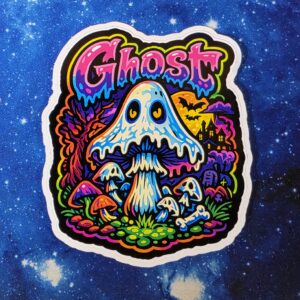
Collecting the family? Add the matching Ghost vinyl sticker – and every order includes a free random sticker regardless.
Frequently Asked Questions
What is Ghost’s lineage?
Ghost is a True Albino Teacher (TAT) family cubensis isolation, commonly associated with the Albino Golden Teacher / TAT genetic branch. It is best understood as a modern albino selection rather than a wild or landrace variety.
How is Ghost different from Yeti?
Both are pale TAT-family isolations and are frequently discussed alongside one another. Ghost is typically described for its clean ivory-to-white “spectral” presentation and dense, sculptural form, with strong blue oxidation contrast against the pale tissue.
What is the difference between a liquid culture and a spore syringe?
A spore syringe carries spores suspended in solution. Spores are genetically varied and have to germinate before any mycelium exists, so what develops can differ from sample to sample. A liquid culture contains living mycelium from a single isolated genetic line that has already been grown out, so you are working with a known, consistent expression from the start and there is no germination stage. For microscopy and taxonomy work that means repeatable observation of the same genetics rather than a mixed population. Every culture we prepare is made in front of a scanned, 99.99% efficient HEPA filter.
How long will my liquid culture stay viable, and how should I store it?
We recommend using your culture within 2 months of receipt for best results. When stored properly it is covered by our 70-day viability guarantee, and properly stored cultures can remain viable for up to 12 months, although viability beyond 70 days is not guaranteed. Keep it refrigerated between 33-40°F and never allow it to freeze. Most cultures survive a single freeze-thaw cycle, but repeated freeze-thaw cycles will kill live mycelium.
What happens if my culture arrives contaminated or does not work?
Every batch is verified contamination-free before it ships, and your order is covered by our 70-Day Guarantee. If a culture arrives contaminated or fails to perform within that window, contact us and we will arrange a replacement or refund. Full terms are set out on our Refund & Replacement Policy page.
Where did True Albino Teacher come from?
By the account relayed on the Shroomery forum in December 2020, True Albino Teacher was found around 2017 by a grower known as Jik Fibs, who saw white fruits appear in an ordinary Golden Teacher grow and took them to agar. Further work produced white gills and spores that looked translucent rather than purple-brown, which is where the true albino label comes from. Ghost and Yeti are among the isolations that came out of that work.
What makes a true albino different from a leucistic line?
In a leucistic line, pigment is reduced but not entirely gone, so faint color can remain and spores are usually still dark. The TAT lines were named true albinos because the original material lost pigment in the spores as well as the fruit body, giving pale gills and near-translucent spores. That spore trait is the most useful thing to document when comparing Ghost with pigmented or leucistic lines.
What do Ghost spores look like under the microscope?
Shape and size follow the species: smooth, subellipsoid, roughly 11 to 17 micrometers long by 7 to 12 wide, with a germ pore. The difference is color. TAT-family spores have been described as translucent or very pale rather than dark purple-brown, so they can be harder to see in brightfield and may benefit from reduced condenser light or a contrast stain.
Have a question we have not covered here? See our full FAQ page.
Additional Information & Research Resources
Documented Origin & Disputed History
Ghost belongs to a family with an unusually specific starting point. According to an account relayed on the Shroomery forum in December 2020, True Albino Teacher was found around 2017 by a grower known as Jik Fibs, who noticed white fruits appearing in a Golden Teacher grow he had been running routinely. The first white fruits still dropped purple spores, so he took them to agar. Later fruits produced white gills, and when he swabbed them the spores appeared translucent. That loss of pigment in the spores themselves is what earned the line the name True Albino Teacher.
From that material came several distinct isolations, including Ghost and Yeti, each selected for its own growth form. The same forum discussion notes that another grower, Dave Wombat, made an independent TAT isolation from similarly unstable Golden Teacher genetics, and Wombat is widely credited with Jack Frost, the TAT × Albino Penis Envy cross. Early notes on Ghost describe smaller fruits and patchier pinning than some sister isolates. These accounts come from breeders and forum posts rather than formal documentation, and we present them as the community records them.
What the Peer-Reviewed Genetics Show
No published study has sequenced Ghost, but its parent line is one of the best characterized in cultivation. McTaggart and colleagues, writing in Current Biology in 2023, found the Golden Teacher population to be among the least genetically diverse they measured, with a mean heterozygosity of 0.0008, an inbreeding coefficient (FIS) of 0.784, and only 3 HD and 5 PR mating-type alleles, consistent with long clonal propagation and selfing.
In plain language: Ghost carries the narrow Golden Teacher background with one recessive trait brought to the surface. Very inbred lines are exactly where recessive traits like albinism tend to appear, because two copies of a hidden variant are more likely to meet. That makes Ghost and its sister isolations a clean natural experiment: the same Teacher genetics with and without pigment.
What Analytical Testing Shows
There is no published laboratory data on Ghost itself. In 2021 Oakland Hyphae ran a preliminary HPLC comparison that included True Albino Teacher alongside Golden Teacher, Burma and other samples; the authors described it as preliminary and not peer reviewed. The strongest reference points for the TAT family come from a 2026 peer-reviewed study in the Journal of Fungi by Sharchaton and colleagues, which grew 14 cubensis strains under identical conditions. Three TAT-family descendants were included: Jack Frost measured 4.95 mg/g total tryptamines, Jack Frost × Golden Teacher 11.38 mg/g and Jack Frost × Shakti 7.29 mg/g. Totals across the study ranged more than 7.8-fold, from 2.62 to 20.65 mg/g.
The takeaway: TAT-family lines can land almost anywhere in the cubensis range depending on what they are crossed with, and albinism alone does not predict chemistry. Ghost potency claims should be treated as unverified until specific testing exists.
Microscopy & Culture Reference Notes
- Spore dimensions: expected within the normal P. cubensis range of roughly 11–17 x 7–12 micrometers, subellipsoid and smooth-walled; published Ghost-specific measurements are not available
- Pigmentation: TAT-family spores have been described as translucent to very pale rather than dark purple-brown; record what you actually see, since expression can vary
- Imaging tip: pale spores show less contrast in brightfield; lowering condenser light or using a contrast stain can make them easier to measure
- Macro reference: white to ivory fruiting bodies with little golden pigment; rounded to convex caps; pale, dense stems; strong blue to blue-gray bruising against the white tissue
- What is observable without spores: vegetative structure – septate hyphae, branching habit and the clamp connections of a dikaryotic basidiomycete
- Suggested workflow: 100x to survey coverage, 400x for spore and gill morphology, 1000x oil immersion for measurement and germ pore detail; run beside Golden Teacher slides to document the pigment difference directly
Ghost on Video
Background viewing from third-party creators. Ghost coverage first, then the Golden Teacher parent line and wider context:
- Ghost Mushrooms Review – April Pride, 12 min. A strain-specific overview of Ghost, its True Albino Golden Teacher background and how it differs from pigmented lines.
- Golden Teacher Mushrooms: What Are They? – DoubleBlind, 21 min. The most thorough overview of the parent line that True Albino Teacher was found in.
- Golden Teacher Mushrooms: What You Need To Know – Third Wave, 6 min. A concise introduction to the Teacher line and its place among classic cubensis varieties.
- The Wild Science Behind Mushroom Strains – North Spore, 9 min. Explains what a strain designation does and does not mean, useful context for a family of isolations from one source.
- The Science of Strains: Golden Teacher vs. Penis Envy – Wonder Fungi, 5 min. Compares the two major branches of cultivated cubensis, the Teacher side that Ghost comes from and the PE side it is often crossed with.
- Fungal Microscopy: How to Mount a Slide, View and Measure Spores – Oregon Mycological Society, 5 min. Not strain-specific, but essential technique for measuring pale spores that are harder to see.
These are third-party videos. We are not affiliated with any of these creators and do not control their content. Links are provided for historical and educational context only.
Important Notice:
Once home, cubensis cultures should be kept in a fridge between 33-40°F to maximize their lifespan. We recommend using them within 2 months. Viability is guaranteed for 70 days when stored properly, and properly stored cultures can last up to 12 months, but this is not guaranteed.
Do not let your cultures freeze! While most will survive one freeze-thaw cycle, multiple freeze-thaw cycles will kill any live mycelium.
This product description is provided strictly for educational, historical, and scientific context. Products are intended for microscopy and taxonomy research only. Not for cultivation or consumption.
We are not able to offer any cultivation or growing information or advice. Any such requests will be ignored.
Please comply with all applicable local, state, and federal laws.




Reviews
There are no reviews yet.