


P. natalensis (South Africa) — Psilocybe Research Culture
Listing Correction Notice (Please Read)
A fascinating African Psilocybe lineage with an important modern taxonomic story.
Important listing update: The genetics we are currently able to supply under this listing are Psilocybe ochraceocentrata (colloquially known as NSS, “Natal Super Strength/Strain”). Recent genomic work indicates that many “P. natalensis” lines in circulation have actually been P. ochraceocentrata. We are actively working on sourcing/isolating legitimate P. natalensis and will update this listing as soon as we have verified, legitimate P. natalensis genetics in hand.
About Psilocybe natalensis: P. natalensis is a psilocybin-producing Psilocybe species originally described from South Africa (KwaZulu-Natal / “Natal”) and formally published in 1995 by Gartz, Reid, Smith, and Eicker. It is frequently discussed alongside Psilocybe cubensis because of close evolutionary relationships and overlapping dung-associated ecology in parts of Africa, but it is a distinct taxon in its own right.
Genetic Lineage & Taxonomic Context
- Target species (true name): Psilocybe natalensis (described 1995)
- Family / order: Hymenogastraceae / Agaricales
- Type locality: Natal (KwaZulu-Natal), South Africa
- Common point of confusion: “Natalensis” as used in hobby genetics is often applied to Psilocybe ochraceocentrata (NSS)
- Current supply for this listing: Psilocybe ochraceocentrata (“NSS”)
Why the confusion matters: Recent phylogenomic work on African Psilocybe clarified that P. ochraceocentrata is a close, free‑living sister lineage to domesticated P. cubensis, while “true” P. natalensis appears to be a different lineage than what many collectors expected. This is an active, fast-moving area of modern mycology.
Geography & Ecology (Field Notes)
- Region: Southern Africa (South Africa; Natal/KwaZulu‑Natal is central to the name and history)
- Ecology (reported): Dung-associated grasslands / enriched soils are commonly referenced for “natalensis-complex” fungi in southern Africa
- Why it matters for study: The “cubensae complex” (including P. cubensis and close relatives) is used to explore domestication, biogeography, and morphological convergence among dung-associated Psilocybe.
Visual Characteristics (Macro Morphology)
Field morphology can vary by region, substrate, and environmental conditions.
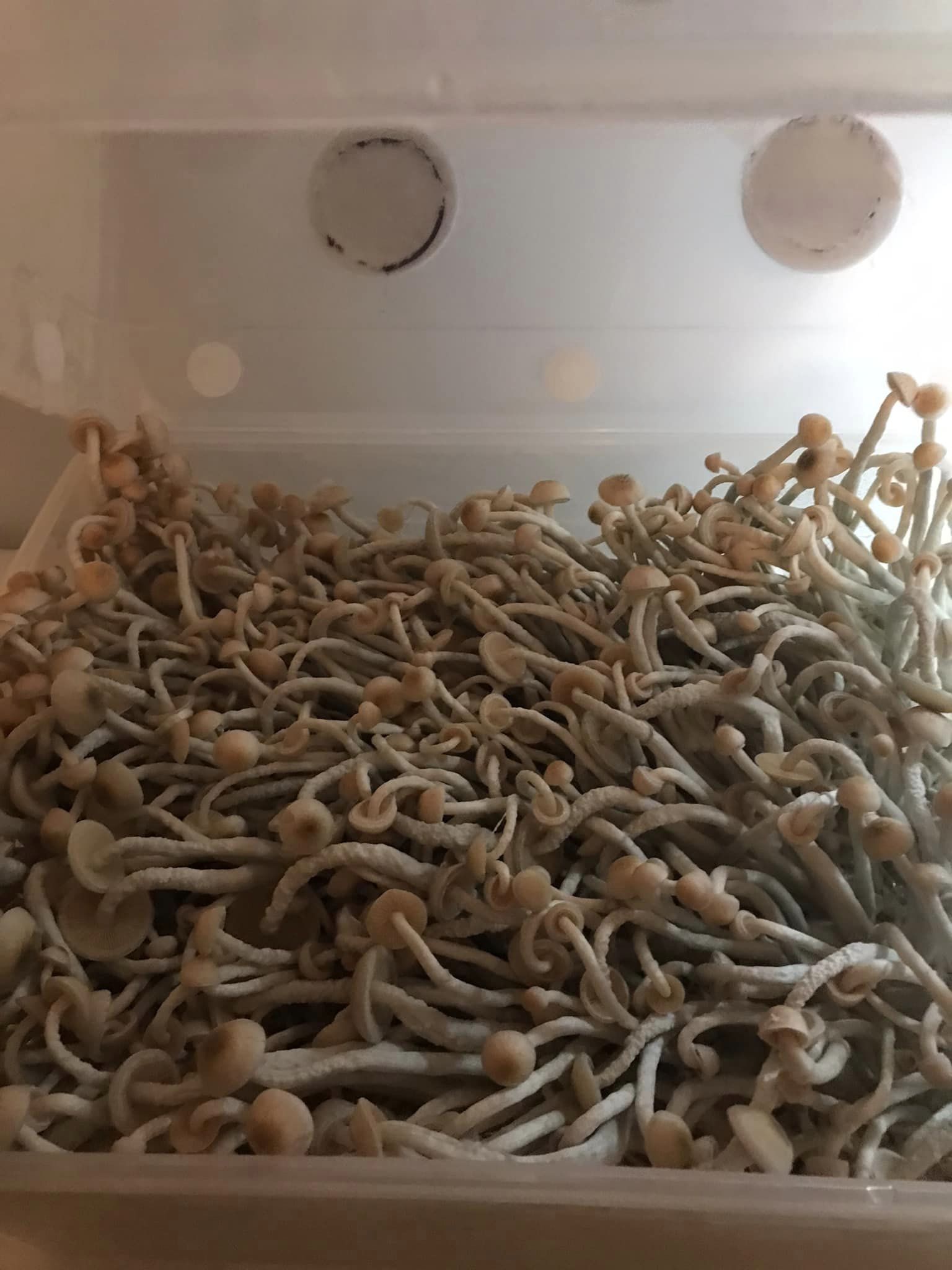
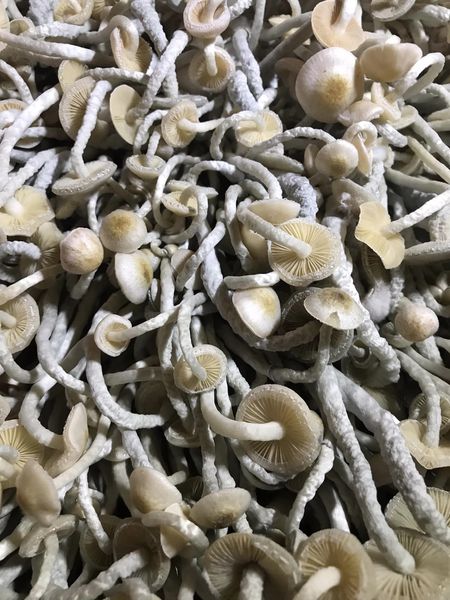
- Cap (reported): Brown to caramel tones; often hygrophanous (color shifts as it dries)
- Cap shape: Convex when young, expanding and flattening with maturity
- Stem: Pale to off-white; overall silhouette is frequently described as “cube-like” by observers
- Veil / annulus: Some sources note a less persistent annulus than typical P. cubensis
- Bruising: Blue oxidation after handling/damage (characteristic of many psilocybin mushrooms)
Microscopy & Taxonomy Notes
- Spore print color (reported): Dark purple-brown (common across many Psilocybe including P. cubensis)
- Spore shape (reported): Elliptical/ellipsoid
- Reported spore size range: ~11–14 × 7–9 μm (varies by source; confirm with your own microscopy measurements)
- Study focus: Compare spores, basidia, and cystidia across related taxa in the cubensae complex; document variability and diagnostic traits
Research Notes (Educational Context Only)
Educational and descriptive context only. Not medical advice.
- Alkaloids: Species in this group are known to contain psilocybin/psilocin (and sometimes related indoles reported in the broader literature)
- Potency claims online: “Natalensis/NSS” is frequently described as stronger than average P. cubensis in anecdotal reports, but potency varies widely by genetics and sample
- Scientific interest: New African Psilocybe discoveries have been used to understand evolutionary relationships, geographic origins, and hidden diversity near P. cubensis.
Cultivation Characteristics (High-Level Overview)
- Community reputation (reported): Often described as robust and vigorous compared with many standard cubensis lines
- Important: For safety and compliance, this section is descriptive only and excludes instructions, parameters, or cultivation techniques.
Collector & Researcher Highlights
- South African lineage: Named for the Natal region; a key species in African Psilocybe discussions
- Modern taxonomy story: “Natalensis vs. NSS” is a real-world example of how DNA-based mycology corrects longstanding misapplied names
- Great for comparative work: Useful alongside P. cubensis and other close relatives for morphology and barcode comparisons
Why liquid culture over spores (for research):
- Cleaner observation: minimal extraneous material for microscopy prep — made in front of a scanned, 99.99% efficient HEPA filter
- Consistent starting material: helpful for repeated comparative study and documentation
- Shelf Life: Use within 2 months for best results; 70-day viability guarantee when stored properly; may remain viable up to 12 months refrigerated (not guaranteed). DO NOT FREEZE.
Shipping: Fast and Free
USPS shipping including all territories including Puerto Rico, U.S. Virgin Islands, Guam, Northern Mariana Islands, and American Samoa. Expedited USPS Priority options available.
Products shipped daily (see our Shipping FAQ page for shipping times and questions) No cheap culture and outrageous shipping cost. What you see is what you pay.
- Satisfaction guarantee on all orders
- Military & First Responder discount available
- Shroomery verified & trusted vendor with 100,000+ cultures shipped
- See what our customers say about us!
- All payment methods are accepted, including cash, money order, debit, credit, cryptocurrency at checkout, Cash App, and Venmo.
Important: Products are strictly intended for microscopy and taxonomy research only. Do not use where prohibited by law. None of our products contain any illegal or active alkaloids at the time of shipment.
Add this South African Psilocybe lineage to your genetic library and explore one of the most discussed modern taxonomy stories in the hobby.
Related Species & Comparison Lines We Carry
As the closest wild relative of P. cubensis, this species is most useful beside cubensis itself and beside the other true species in the library:
- Golden Teacher – the reference line for its domesticated sister species, P. cubensis, and the most important side-by-side comparison
- Purple Mystic – a cubensis line taken from a wild Florida population, useful for comparing a wild-collected cubensis with its wild African relative
- Psilocybe azurescens – a wood-loving Psilocybe from a very different branch of the genus
- Hawaiian Panaeolus cyanescens (Pan Cyan) – a psilocybin species from an entirely different genus, for comparing spore shape and color
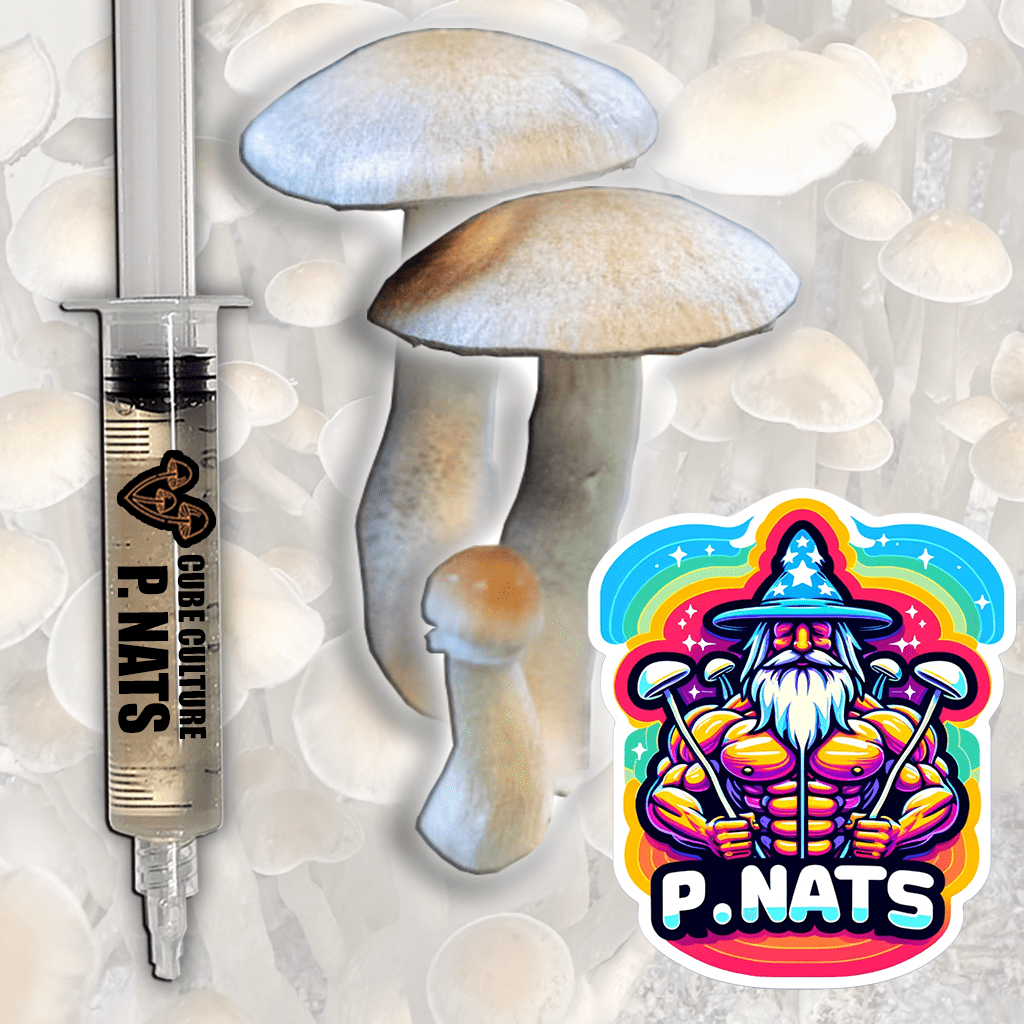
Collecting the family? Add the matching P. Nats vinyl sticker – and every order includes a free random sticker regardless.
Frequently Asked Questions
Is this the same as Psilocybe natalensis?
This line is cataloged under P. ochraceocentrata, the currently accepted name for the African species long circulated in collector libraries as Psilocybe natalensis. Older references and many vendor listings still use the natalensis name for the same material.
How does it differ from Psilocybe cubensis?
It is a separate African Psilocybe species rather than a cubensis cultivar, placed in Hymenogastraceae (Agaricales) with a type locality of Natal (KwaZulu-Natal), South Africa. That makes it a genuinely different taxonomic subject for comparison, not another strain of the same species.
What is the difference between a liquid culture and a spore syringe?
A spore syringe carries spores suspended in solution. Spores are genetically varied and have to germinate before any mycelium exists, so what develops can differ from sample to sample. A liquid culture contains living mycelium from a single isolated genetic line that has already been grown out, so you are working with a known, consistent expression from the start and there is no germination stage. For microscopy and taxonomy work that means repeatable observation of the same genetics rather than a mixed population. Every culture we prepare is made in front of a scanned, 99.99% efficient HEPA filter.
How long will my liquid culture stay viable, and how should I store it?
We recommend using your culture within 2 months of receipt for best results. When stored properly it is covered by our 70-day viability guarantee, and properly stored cultures can remain viable for up to 12 months, although viability beyond 70 days is not guaranteed. Keep it refrigerated between 33-40°F and never allow it to freeze. Most cultures survive a single freeze-thaw cycle, but repeated freeze-thaw cycles will kill live mycelium.
What happens if my culture arrives contaminated or does not work?
Every batch is verified contamination-free before it ships, and your order is covered by our 70-Day Guarantee. If a culture arrives contaminated or fails to perform within that window, contact us and we will arrange a replacement or refund. Full terms are set out on our Refund & Replacement Policy page.
How was Psilocybe ochraceocentrata discovered?
It was identified by a team led by researchers from Stellenbosch University, Clark University, the University of Utah and the Natural History Museum of Zimbabwe, who compared DNA from African Psilocybe collections, including type specimens. The holotype was collected in January 2013 in the Matobo Hills of Zimbabwe, and the species was also found in grasslands of South Africa. The study was published in Proceedings of the Royal Society B in 2026 after appearing as a preprint in late 2024.
Why was NSS sold as Psilocybe natalensis?
For years, the popular cultivated line known as Natal Super Strength (NSS), also sold as Transkei, was assumed to be P. natalensis, a species described from KwaZulu-Natal in 1995. When the researchers compared publicly deposited DNA sequences for NSS with the P. natalensis type specimen, they did not match. Most instead grouped with the newly recognized P. ochraceocentrata, which is why we now list this culture under that name.
What does its discovery say about where cubensis came from?
The study estimated that P. ochraceocentrata and P. cubensis last shared a common ancestor about 1.5 million years ago, long before cattle were domesticated. That supports an African origin for the cubensis lineage and challenges the long-held idea, proposed by Gastón Guzmán in 1983, that cubensis only reached the Americas with Spanish cattle around 1500. Niche modeling in the same study suggested suitable habitat for these species across Africa, Asia and the Americas over the past 3 million years.
Have a question we have not covered here? See our full FAQ page.
Additional Information & Research Resources
A Species Named in 2026
This culture has one of the most unusual histories in the library: for years it was sold under the wrong species name. The cultivated line known as Natal Super Strength (NSS), also sold as Transkei, circulated widely as Psilocybe natalensis, a species formally described from KwaZulu-Natal, South Africa, in 1995. It became one of the most popular non-cubensis cultures in hobby collections.
That changed with a study by Breyten van der Merwe, Alexander Bradshaw, Bryn Dentinger, Keaton Tremble, Cathy Sharp and colleagues, first posted as a preprint in December 2024 and published in Proceedings of the Royal Society B in 2026. Using DNA from type specimens of the known African Psilocybe species, they recognized a new species, P. ochraceocentrata, named for the ochre-yellow center of its cap. When they checked publicly deposited sequences for the commercial NSS line against the P. natalensis type specimen, the NSS sequences did not match; four of the five grouped with the new species instead. The holotype comes from the Matobo Hills of Zimbabwe, collected in January 2013 in leaf litter on granitic sand, and the species has also been found in South African grasslands and on dung.
What the Peer-Reviewed Genetics Show
The same study found P. ochraceocentrata to be the closest free-living relative of P. cubensis. Molecular clock analysis placed their last common ancestor about 1.5 million years ago, with a 95 percent range of roughly 710,000 to 2.55 million years. Even the most recent estimate long predates cattle domestication and modern humans. Both species are associated with herbivore dung, which the authors suggest predisposed cubensis to its later specialization on cattle dung.
That finding tests a hypothesis first proposed by the Psilocybe specialist Gastón Guzmán in 1983: that cubensis had an African ancestor but reached the Americas only when cattle were introduced around 1500. The new work supports the African origin but suggests cubensis-type fungi may have been present across Africa, Asia and the Americas far earlier, with niche modeling indicating suitable habitat on all three continents over the last 3 million years.
In plain language: this culture is not a cubensis strain at all, but it is the closest thing to a wild cousin that cubensis has. That makes it one of the most scientifically interesting cultures in any library, and the single best comparison for understanding what domestication has done to cubensis.
What Analytical Testing Shows
NSS has long been described in hobby communities as stronger than average cubensis, but published, controlled potency data on P. ochraceocentrata is still limited, and older reports filed under “natalensis” may refer to either species. For context, a 2026 peer-reviewed study in the Journal of Fungi that grew 14 cubensis strains under identical conditions found totals ranging more than 7.8-fold, from 2.62 to 20.65 mg/g. Potency claims for this culture should be treated as unverified until species-specific testing is published.
Microscopy Reference Data
- Spore dimensions (holotype): (11) 11.8 (12.5) x (6.5) 7.6 (8.0) micrometers, Q about 1.44–1.71 (mean 1.55); other collections vary, and some carry more lens-shaped spores
- Shape: ellipsoid, a few lenticular; thick-walled and smooth, with a germ pore
- Basidia: elongate to clavate, 22–38 x 8–12.5 micrometers, four-spored with sterigmata 4–5 micrometers long
- Pigmentation: dark purple-brown deposits, similar to P. cubensis
- Macro reference (holotype): fruiting bodies up to about 105 mm tall in tight clusters; caps 65–75 mm, cream at first, then vinaceous-gray with an ochre to tawny center and paler yellowish margin, convex to flat and often undulating; flesh cream and firm; gills adnate, darkening to near-black; bruises blue-green
- Suggested workflow: 400x for spore shape and basidia, 1000x oil immersion for measurement and Q-value; measure at least 30 spores and compare directly with a P. cubensis slide, since the two species overlap closely
P. ochraceocentrata on Video
Background viewing from third-party creators. Coverage of the new species and its discovery first, then technique:
- Going Crazy for Ochracies – The MycoGeeky Podcast, 3 hr 27 min. An in-depth conversation with a mycologist about the paper describing P. ochraceocentrata and what it means for cultivated NSS.
- The Fungi Files #002: Discussing the Psilocybe ochraceocentrata Preprint – Fungi Files, 1 hr 8 min. A panel discussion and informal peer review of the preprint, covering the taxonomy and the NSS naming question.
- Magic Hour! Growing Natalensis Mushrooms – Shroom Bloom, 1 min. A time-lapse of culture sold as natalensis, showing the clustered, pale fruiting bodies described in the species account.
- The Wild Science Behind Mushroom Strains – North Spore, 9 min. Background on cubensis strains, the domesticated sister species this culture is compared against.
- Fungal Microscopy: How to Mount a Slide, View and Measure Spores – Oregon Mycological Society, 5 min. Not species-specific, but essential technique for measuring spores and calculating Q-values yourself.
These are third-party videos. We are not affiliated with any of these creators and do not control their content. Links are provided for historical and educational context only.
Important Notice:
Once home, live cultures should be kept in a fridge between 33–40°F to maximize their lifespan. We recommend using them within 2 months. Viability is guaranteed for 70 days when stored properly, and properly stored cultures can last up to 12 months, but this is not guaranteed. Do not let your cultures freeze.
This product description is provided strictly for educational, historical, and scientific context.
We are not able to offer any cultivation or growing information or advice. Any such requests will be ignored.
Products are intended for microscopy and taxonomy research only. Not for cultivation or consumption.
Please comply with all applicable local, state, and federal laws.


Todd –
On my 5th flush, keeps on giving. Got it last time they had it. Order another batch and it Shipped promptly!
Angela S. –
Luvit
K S. –
Very clean sample like usual, shipping very fast, descreate, and private. Testing already underway day 6!
Mark P. –
These guys are the bomb!
Jack –
Had several good experiences and then this happened. Better genetics on. Sporeswap anyway.
Janet N. –
I haven't started these yet, but I did grow some of your hillbillies and they turned out fantastic
Mark Pearson (verified owner) –
Cube culture is my main and only vendor when it comes to my mycology needs. Price is in point and quality is always there. Always Awesome with some extra goodies with my orders🫶🏽🫶🏽🫶🏽🫶🏽
Melanie M. (verified owner) –
Michael R. (verified owner) –
Nice culture
Natalie (verified owner) –
Ashton P. (verified owner) –
I have gotten many things and have never had any contam. Love the free and speedy shipping even during the holidays. I will continue to use cube culture to continue to expand my genetics.
Anonymous (verified owner) –
Excellent
CamRon Beck (verified owner) –
Will buy from here again thank you
Eric (verified owner) –
Ordering again right now!
Will (verified owner) –
Very reliable delivery and quality
Sam M. (verified owner) –
Anonymous (verified owner) –
Darrin Mccoy (verified owner) –
Idk still hope it takes longer to colonize but it’s been over 6 weeks and it’s still not there
Michael West (verified owner) –
Great spores for study
Anonymous (verified owner) –
Jessica Griffin (verified owner) –
Wonderful as always
Jeremy Morelli (verified owner) –
Received first culture and had a problem with contam. CubecultureUSA was quick to supply me with not only a replacement culture syringe, but they tossed in an additional culture syringe of Hillbillies at no charge! The results results with the replacement P. Nats were successful and lived up to the description and then some! Definitely a great culture for taxonomy and research! I just started my observations of the complimentary culture, but so far so good! I must note that I also had good support from my mycology supply vendor who also replaced my spawn bag immediately upon my reporting the initial failure, so I cannot assign blame to them or CubecultureUSA, both handled the situation (which was probably caused by my inexperience in this new hobby) exceptionally professionally and I am an extremely satisfied customer after seeing how well I was treated! I’ll be checking CubecultureUSA soon for a new culture to research for sure, and I’d recommend them to anyone who is not only looking for great research culture genetics, but also peace of mind that if you run into any issues CubecultureUSA backs up their products with a guarantee that they stand by MORE THAN 100 %!!! To me… A+ customer service after a merchant has already been paid is priceless and sets them above a vendor just out to make a profit!
Bonus points… STICKERS!!! Each package included a nice 5″ approximately laminated sticker! Just thought it was a nice touch 😉
J. Morelli – September ’25
bill (verified owner) –
Quick shipping, one click payment
Spores are alive and well!
Charles P. (verified owner) –
Very good service, they have the best culture’s I highly recommend them.
Moshe E. (verified owner) –
Great company five star all the way around customer service amazing
on top of super quick shipping and great lc prices and quality contamination free exotics cultures for beginners at experts
Mitchell R. (verified owner) –
Always great service and great products and great prices!
Michael (verified owner) –
Quick response, arrived in good shape.
Jesus Sianez (verified owner) –
Miguel (verified owner) –
Fast and reliable have ordered 3 times and all 3 were good quality.Also, customer service has fast response and solved an issue when I input the wrong address and mistyped my email, I’m very satisfied.
Christopher (verified owner) –
Great people fast delivery and the only guys I’ll order from
Kyle (verified owner) –