
Purple Mystic | Florida-Origin P. cubensis Genetics
A rare, story-rich cubensis lineage with unmistakable collector appeal.
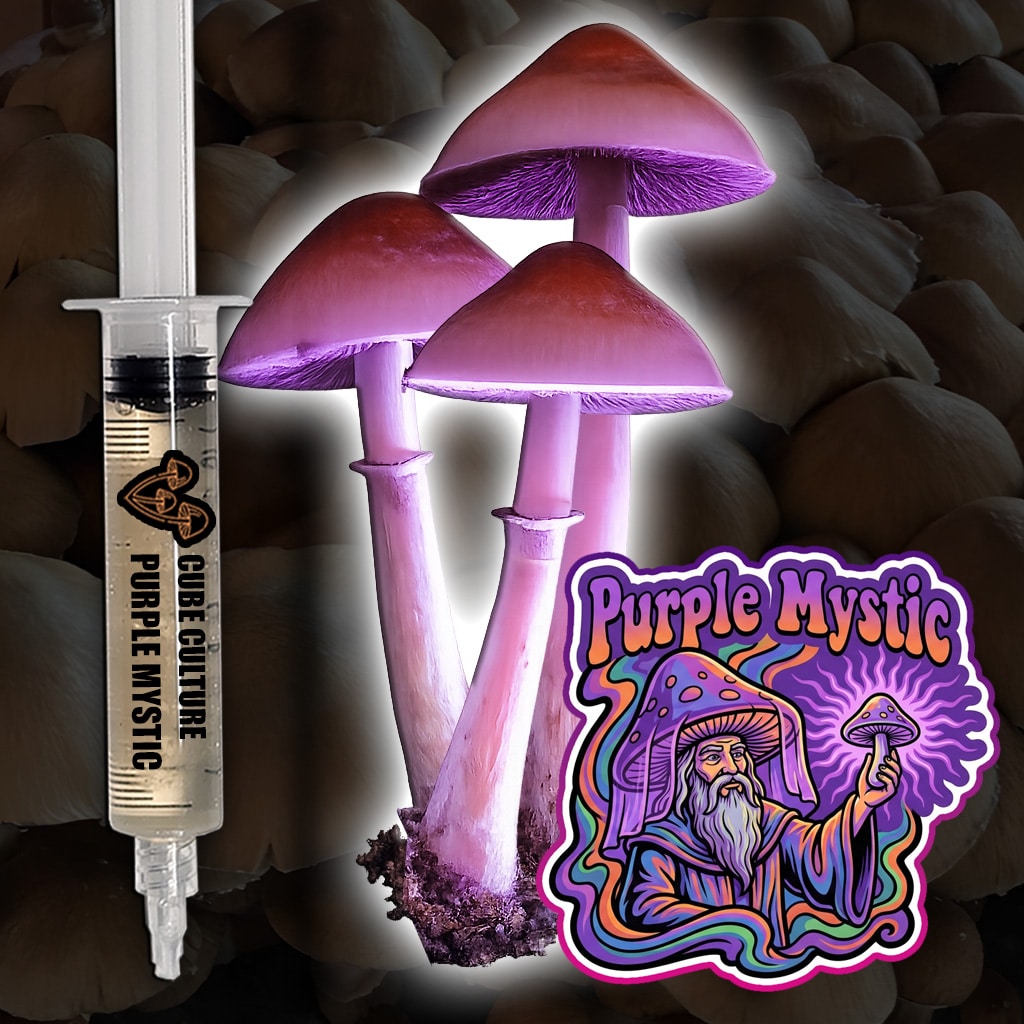
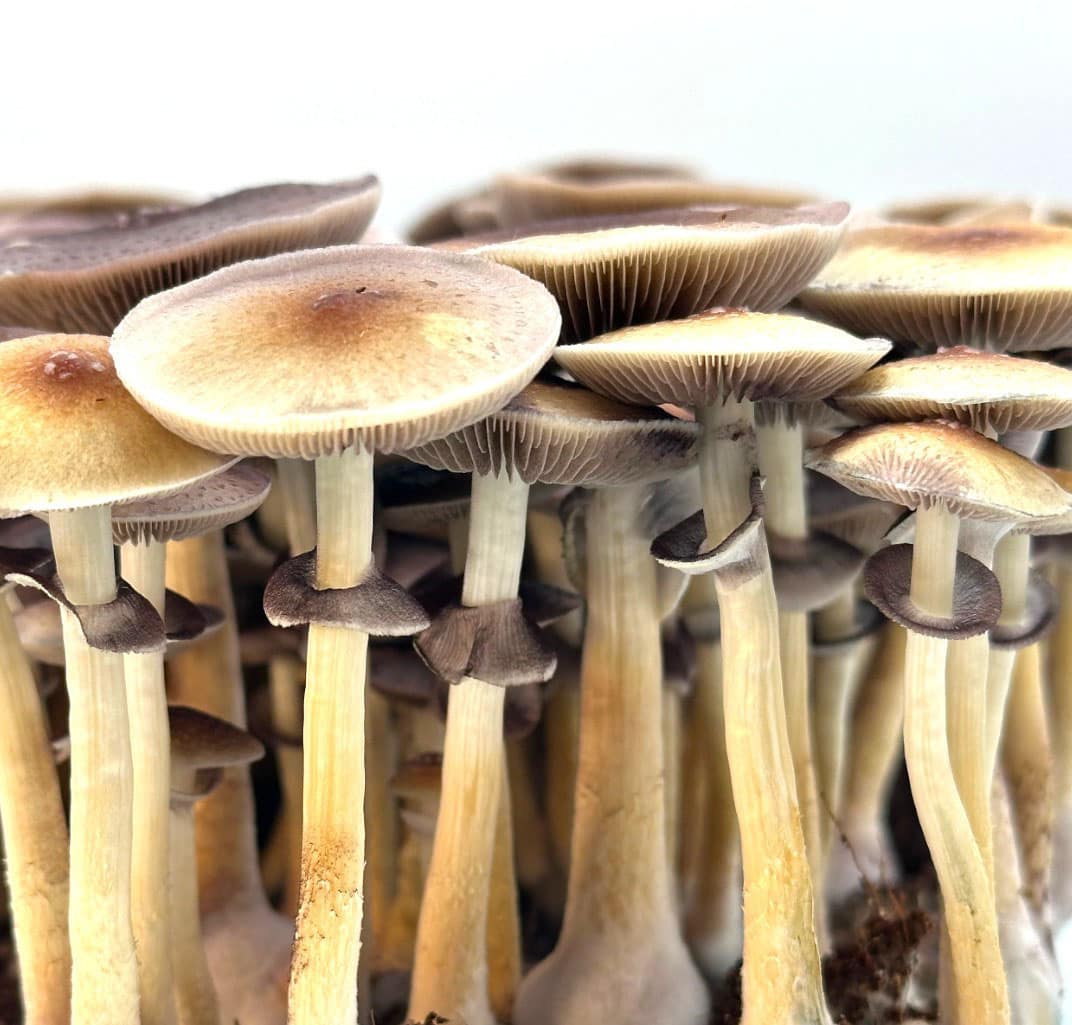
Purple Mystic is a distinctive Psilocybe cubensis variety known for its Florida origin story, purple-brown spore coloration, and classic wild-type cubensis structure. Often associated with East Plant City, Florida, Purple Mystic has become a memorable name in modern mycology because of its regional backstory, vigorous reputation, and eye-catching presence in microscopy and taxonomy collections.
Genetic Lineage & Historical Context
- Species: Psilocybe cubensis
- Lineage status: Florida landrace-derived cubensis variety / community-designated lineage
- Reported origin: Widely associated with East Plant City / Plant City, Florida, an area known for warm, humid pastureland and naturally occurring cubensis populations.
- Name background: The “Purple” name is commonly linked to its dark purplish-brown spore coloration, while “Mystic” reflects the folklore and collector interest surrounding its Florida discovery story.
Purple Mystic is not a formally recognized taxonomic subspecies; it is best understood as a named P. cubensis variety preserved and circulated through modern microscopy and genetic-library communities.
Visual Characteristics (Macro Morphology)
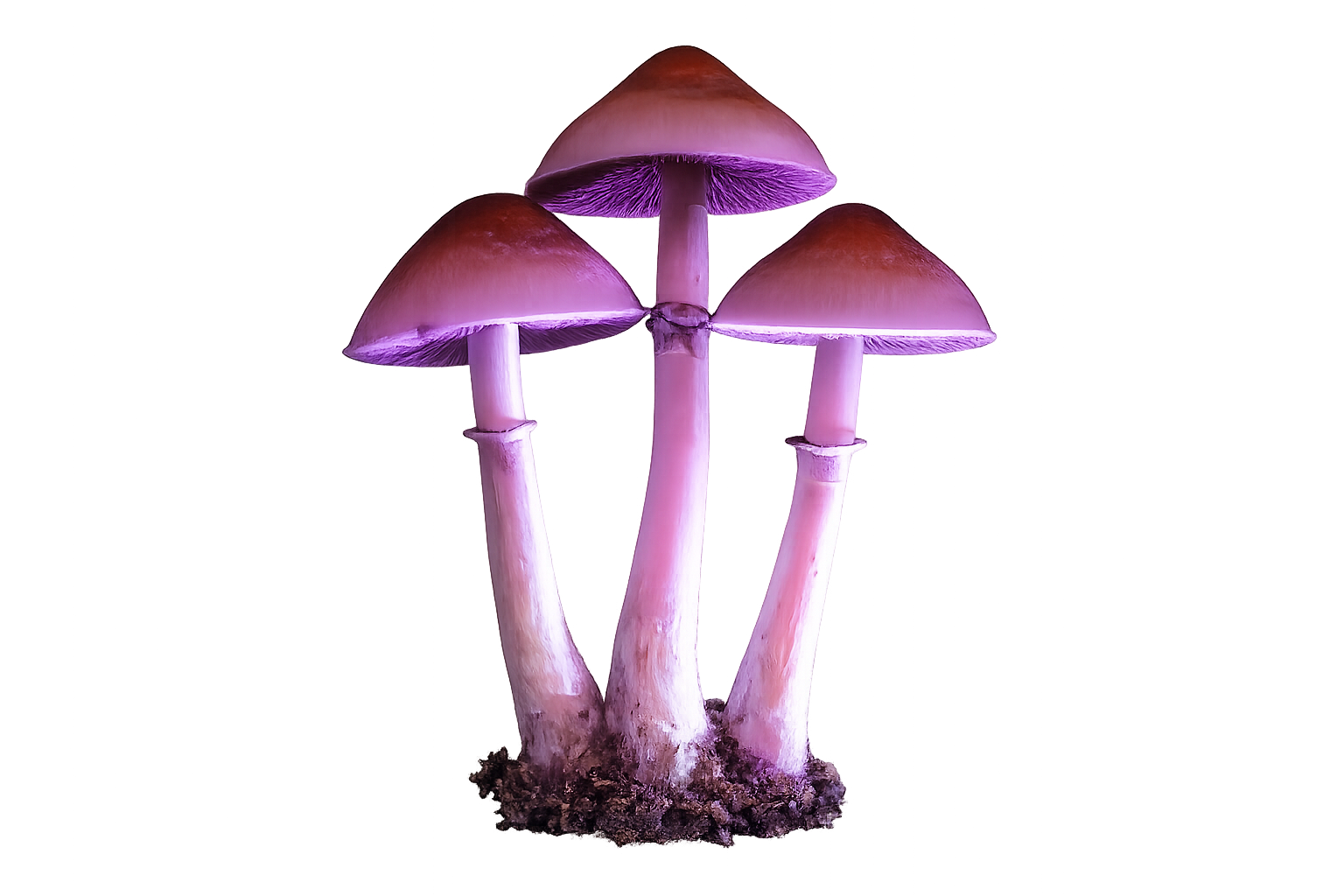
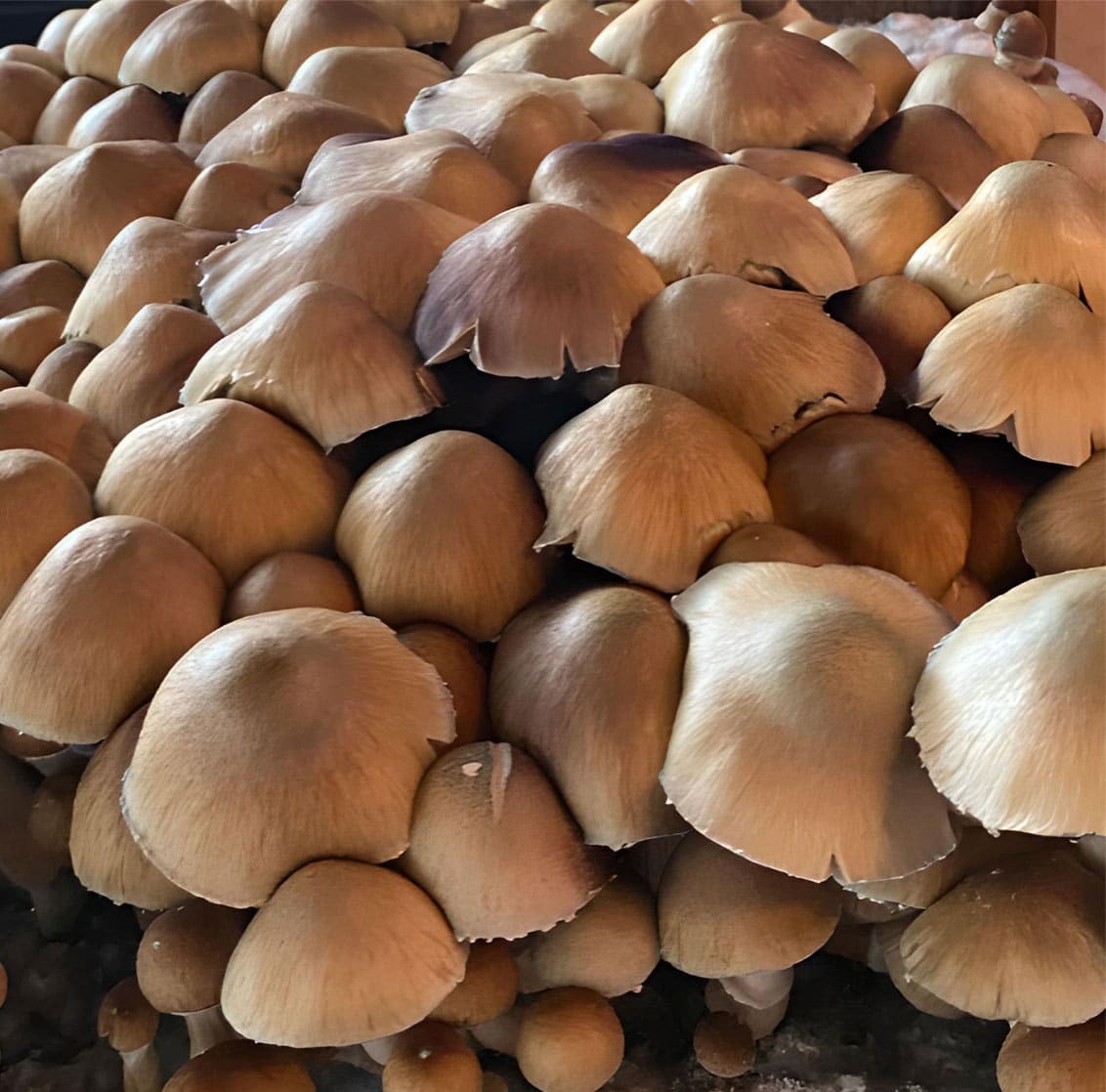
- Cap coloration: Caramel, tan, chestnut-brown, to golden-brown tones, often becoming lighter toward the cap margin with age
- Cap shape: Conic to convex when young, later broadening or flattening with maturity; some specimens may show a subtle central umbo
- Stem: Pale cream to off-white, commonly described as medium to tall with a classic cubensis build
- Spore deposit: Heavy purple-brown to dark purplish-brown coloration is one of the most recognized traits associated with the Purple Mystic name
- Veil remnants: Partial veil may leave a visible annular ring typical of P. cubensis
- Bruising: Blue oxidation may appear where tissue is handled, stressed, or damaged
Microscopy & Taxonomy Notes
- Spore print color: Dark purplish-brown, consistent with typical P. cubensis identification traits
- Gill structure: Crowded gills that mature from lighter grayish tones toward darker purplish-brown as spores develop
- Taxonomic placement: Kingdom Fungi, Division Basidiomycota, Class Agaricomycetes, Order Agaricales, Family Hymenogastraceae, Genus Psilocybe, Species Psilocybe cubensis
- Why Purple Mystic is favored: Its Florida-origin story, purple-brown spore presentation, and recognizable wild-type morphology make it a compelling comparison variety for microscopy libraries.
Research Notes (Educational Context)
Educational and descriptive context only.
- Potency (reported): Often described in anecdotal literature as moderate to above average, though potency can vary significantly between individual specimens and research samples.
- Common descriptive language: Mystical, colorful, expansive, euphoric, and introspective are frequently used descriptors in anecdotal and collector discussions.
- Analytical relevance: Useful as a regional comparison point when studying Florida-associated cubensis varieties and wild-type cubensis morphology.
- Collector relevance: Less common than benchmark varieties such as Golden Teacher or B+, which gives Purple Mystic added appeal for genetic-library collectors seeking a Florida-origin lineage.
Habitat & Regional Background (Historical Context)
- Regional association: Frequently connected to Florida pastureland, especially the East Plant City / Plant City area
- Natural ecology: P. cubensis is a dung-loving species associated with warm, humid, tropical to subtropical environments and grazed fields.
- Historical significance: Its named-location story helps separate Purple Mystic from many modern varieties whose origins are less clearly documented or more heavily mixed through later breeding work.
This habitat section is provided for historical, ecological, and taxonomy context only and is not cultivation guidance.
Cultivation Characteristics (High-Level Overview)
- Difficulty: Often described by the community as approachable and resilient, with wild-type cubensis behavior
- Growth behavior: Reported to show vigorous mycelial expression and productive, classic cubensis morphology when studied by qualified researchers
- Environmental tolerance: Associated with Florida-derived genetics and a reputation for strong performance under proper legal laboratory handling
For safety and compliance, this section is descriptive only and excludes instructions, parameters, substrates, or cultivation techniques.
Collector & Researcher Highlights
- Florida-origin appeal: A memorable regional cubensis variety tied to East Plant City / Plant City, Florida
- Distinctive spore coloration: Known for dark purple-brown spore presentation typical of cubensis but emphasized in the Purple Mystic name
- Wild-type structure: A useful comparison variety for observing classic cubensis cap, gill, veil, stem, and bruising traits
- Abbreviation: Commonly referred to as PM or Purple Mystic
Why liquid culture over spores (for research):
- Established genetics: derived from a selected, isolated Purple Mystic lineage for consistent research observation
- Cleaner observation: minimal extraneous material for microscopy prep – Made in front of a scanned, 99.99% efficient HEPA filter
- Reliable morphology: ideal for repeated comparative study against other cubensis varieties
- Shelf Life: Use within 2 months for best results; 70-day viability guarantee when stored properly; may remain viable up to 12 months refrigerated (not guaranteed). DO NOT FREEZE.
Shipping: Fast and Free USPS shipping including all territories including Puerto Rico, U.S. Virgin Islands, Guam, Northern Mariana Islands, and American Samoa. Expedited USPS Priority options available. Products shipped daily (see our Shipping FAQ page for shipping times and questions) No cheap culture and outrageous shipping cost. What you see is what you pay.
- Satisfaction guarantee on all orders
- Military & First Responder discount available
- Shroomery verified & trusted vendor with 100,000+ cultures shipped
- See what our customers say about us!
- All payment methods are accepted, including cash, money order, debit, credit, cryptocurrency at checkout, Cash App, and Venmo.
Important: Products are strictly intended for microscopy and taxonomy research only. Do not use where prohibited by law. None of our products contain any illegal or active alkaloids at the time of shipment.
Add Purple Mystic to your genetic library and explore a Florida-origin cubensis lineage with one of the most memorable stories in modern P. cubensis research.
Florida & Classic Companion Lines We Carry
Purple Mystic belongs to a small group of cubensis lines with Florida roots. These sit naturally beside it in a comparative library:
- Treasure Coast (TC) – another Florida-named line, and the most direct regional comparison for Purple Mystic
- B+ (B Positive) – a classic line most often traced to a Florida grower in the 1990s, useful for comparing an older Florida story with a more recent wild find
- Golden Teacher – the species reference baseline, and the benchmark every wild-type cubensis is measured against
- Burma – a wild-collected line from Southeast Asia, a useful geographic contrast to a Florida pasture find
Collecting the family? Add the matching Purple Mystic vinyl sticker – and every order includes a free random sticker regardless.
Frequently Asked Questions
Where does Purple Mystic come from?
Purple Mystic is a Florida landrace-derived cubensis line, widely associated in collector accounts with the East Plant City / Plant City area of Florida. It is a community-preserved regional line rather than a modern designer hybrid.
Why is Purple Mystic considered rare?
It circulates far less widely than mainstream cubensis lines, and much of what is documented about it comes from collector accounts rather than large-scale distribution. That relative scarcity is why it tends to be kept as a distinct entry in a genetic library.
What is the difference between a liquid culture and a spore syringe?
A spore syringe carries spores suspended in solution. Spores are genetically varied and have to germinate before any mycelium exists, so what develops can differ from sample to sample. A liquid culture contains living mycelium from a single isolated genetic line that has already been grown out, so you are working with a known, consistent expression from the start and there is no germination stage. For microscopy and taxonomy work that means repeatable observation of the same genetics rather than a mixed population. Every culture we prepare is made in front of a scanned, 99.99% efficient HEPA filter.
How long will my liquid culture stay viable, and how should I store it?
We recommend using your culture within 2 months of receipt for best results. When stored properly it is covered by our 70-day viability guarantee, and properly stored cultures can remain viable for up to 12 months, although viability beyond 70 days is not guaranteed. Keep it refrigerated between 33-40°F and never allow it to freeze. Most cultures survive a single freeze-thaw cycle, but repeated freeze-thaw cycles will kill live mycelium.
What happens if my culture arrives contaminated or does not work?
Every batch is verified contamination-free before it ships, and your order is covered by our 70-Day Guarantee. If a culture arrives contaminated or fails to perform within that window, contact us and we will arrange a replacement or refund. Full terms are set out on our Refund & Replacement Policy page.
Who found Purple Mystic?
The line is credited to a Florida hobbyist posting as Blackd0ve420, who shared the find on the Shroomery forum in December 2016 and described collecting the original wild mushroom in East Plant City roughly a decade earlier. The name Purple Mystic was coined for that collection. As with most wild finds, the account comes from the collector rather than from formal documentation.
Is Purple Mystic a true landrace?
It is best described as a wild-collected Florida line rather than a landrace in the strict sense. Psilocybe cubensis has long been associated with cattle pastures in Florida. The traditional view was that it reached the Americas with Spanish cattle around 1500, though a 2026 study of its closest wild African relative suggests cubensis-type fungi may have been present far earlier. Purple Mystic is a sample from that naturalized population, preserved and circulated by collectors, rather than a lineage bred for specific traits.
What do Purple Mystic spores look like under the microscope?
Typical of the species. Spores are smooth, subellipsoid and dark purple-brown in transmitted light, with a truncate germ pore, and fall within the normal P. cubensis range of roughly 11 to 17 micrometers long by 7 to 12 wide. The line opens fully and prints heavily, which is where the purple in its name comes from.
Have a question we have not covered here? See our full FAQ page.
Additional Information & Research Resources
Documented Origin & Disputed History
Purple Mystic has a more specific origin story than most named cubensis lines, because it can be traced to one collector and one place. The line is credited to a Florida hobbyist posting as Blackd0ve420, who shared the find on the Shroomery forum in December 2016. By his account, the original mushroom was collected from pastureland in East Plant City, in Hillsborough County east of Tampa, roughly a decade before that post. The name Purple Mystic was coined for the collection and has stayed with it as it passed between collectors.
The setting matters. P. cubensis is a dung-loving species of warm, grazed land, and Florida has been cattle country since Spanish settlers brought livestock in the sixteenth century. Central Florida pastures have long been one of the best-known places in the United States to find wild cubensis. The account comes from the collector himself rather than from any formal record, so we present it as the community records it rather than as settled fact.
What the Peer-Reviewed Genetics Show
No published study has sequenced Purple Mystic itself, but population genomics offers useful context for Florida-named lines. McTaggart and colleagues, writing in Current Biology in 2023, found cultivated P. cubensis lines to be closely related and low in genetic diversity compared with naturalized wild populations. Treasure Coast, another Florida-named cultivar, was among the lines showing evidence of sibling relationships, consistent with descent from a single parent mushroom. The authors also cautioned that place names attached to cultivars do not always indicate where the genetics actually came from.
In plain language: a line taken directly from a wild pasture population, as Purple Mystic is reported to be, is exactly the kind of material that can add something to a library dominated by long-inbred cultivars. That is also why keeping it as a single isolated culture matters. It preserves one specific wild genotype rather than a mixed spore population.
Where the Name Comes From
The purple in Purple Mystic refers to its spores. Like all P. cubensis, it drops a dark purple-brown print, and the line is noted for heavy, richly colored deposits. There is no evidence of unusual spore pigmentation beyond the species norm; the name highlights a trait every cubensis has rather than one unique to this line. That makes it a good specimen for print and slide work rather than a pigmentation curiosity.
What Analytical Testing Shows
There is no published laboratory data on Purple Mystic. The closest peer-reviewed reference point is a 2026 study in the Journal of Fungi by Sharchaton and colleagues, which grew 14 cubensis strains under identical conditions and found total tryptamines varying more than 7.8-fold between strains, from 2.62 to 20.65 mg/g, with individual fruiting bodies within one strain varying by 12.8 to 23.4 percent in psilocybin. Reported potency for any named line, including this one, should be treated as unverified until specific testing exists.
Microscopy Reference Data
- Spore dimensions: within the normal P. cubensis range of roughly 11–17 x 7–12 micrometers; published Purple Mystic-specific measurements are not available
- Shape: subellipsoid, smooth-walled, no surface ornamentation
- Germ pore: truncate at the apical end, resolvable at 1000x oil immersion
- Pigmentation: dark purple-brown under transmitted light, non-amyloid; prints heavy and dark
- Macro reference: caramel to chestnut and golden-brown caps, conic to convex and flattening with age, sometimes with a subtle umbo; pale cream stems of medium to tall build with a ring zone; blue bruising where handled
- Suggested workflow: 100x to confirm coverage and distribution, 400x for primary morphological observation, 1000x oil immersion for measurement and germ pore detail; run beside Treasure Coast for a regional comparison
Purple Mystic on Video
Background viewing from third-party creators. Strain-specific footage is scarce, so coverage of wild cubensis in Florida comes first, then wider context and technique:
- Identifying the Most Common Psilocybe Mushroom Found in Florida – Wipsi Myco Research, 2 min. A 360-degree look at wild P. cubensis in its natural Florida pasture habitat, the kind of setting Purple Mystic was collected from.
- Psilocybin-Containing Mushrooms of Florida – Scott Ostuni, 33 min. A presentation on the diversity of psilocybin species found across Florida, with useful context on where cubensis fits.
- The Wild Science Behind Mushroom Strains – North Spore, 9 min. Explains what a strain designation does and does not mean, which matters for any line named after a place.
- The 5 Most Popular Psilocybin Mushroom Strains – Third Wave, 7 min. Context on the best-known cubensis varieties that Purple Mystic is usually compared with.
- Golden Teacher Mushrooms: What Are They? – DoubleBlind, 21 min. The reference line for wild-type cubensis morphology, useful for side-by-side comparison.
- Fungal Microscopy: How to Mount a Slide, View and Measure Spores – Oregon Mycological Society, 5 min. Not strain-specific, but the most useful video here if you are doing the measurement work yourself.
These are third-party videos. We are not affiliated with any of these creators and do not control their content. Links are provided for historical and educational context only.
Important Notice:
Once home, cubensis cultures should be kept in a fridge between 33-40°F to maximize their lifespan. We recommend using them within 2 months. Viability is guaranteed for 70 days when stored properly, and properly stored cultures can last up to 12 months, but this is not guaranteed.
Do not let your cultures freeze! While most will survive one freeze-thaw cycle, multiple freeze-thaw cycles will kill any live mycelium.
This product description is provided strictly for educational, historical, and scientific context. Products are intended for microscopy and taxonomy research only. Not for cultivation or consumption.
We are not able to offer any cultivation or growing information or advice. Any such requests will be ignored.
Please comply with all applicable local, state, and federal laws.


Ryan (verified owner) –
Healthy, great prices, and fast shipping!!!