


Albino Bluey Vuitton | Boutique Albino P. cubensis Genetics
A luxury-tier modern cubensis hybrid with ghost-white expression and blue-toned morphology.
Albino Bluey Vuitton (often abbreviated ABV) is a highly sought-after modern Psilocybe cubensis variety known for its pale albino presentation, dense fruit body structure, and striking blue-to-silver visual traits. Developed from the Bluey Vuitton family of genetics, ABV is commonly associated with the Panama × Melmac PE heritage behind the original Bluey Vuitton line and is valued by collectors and microscopy researchers for its distinctive appearance, refined hybrid background, and strong visual identity.
Genetic Lineage & Historical Context
- Species: Psilocybe cubensis
- Common abbreviation: ABV
- Lineage status: Modern albino/isolation expression from the Bluey Vuitton genetic family
- Reported heritage: Bluey Vuitton is widely described in public mycology circles as a Panama × Melmac PE hybrid, with ABV representing an albino expression or refined isolation of that line
- Era of circulation: Contemporary collector variety popularized through online microscopy, spore, and genetics communities during the 2020s
Albino Bluey Vuitton is best understood as a modern designer cubensis line rather than an older landrace variety. Its appeal comes from combining the visual drama of albino morphology with the dense structure and blue-toned traits associated with Bluey Vuitton genetics.
Visual Characteristics (Macro Morphology)
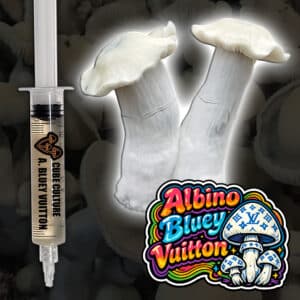
- Cap coloration: Pale white to ivory, often developing silver-blue, steel-blue, or light bluish tones with maturity or handling
- Cap shape: Frequently thick, rounded, and substantial; may mature into broad caps with a dense, boutique appearance
- Center coloration: Some public descriptions note a more noticeable blue tone toward the center of the cap
- Stem: Thick, sturdy, and pale white to cream; often described as dense and robust compared with many classic cubensis varieties
- Overall structure: Short-to-medium, heavy-bodied, and visually compact, reflecting influence commonly attributed to Melmac / Penis Envy-type morphology
- Bruising: Blue oxidation upon handling or damage, often visually dramatic against the pale albino tissue
Microscopy & Taxonomy Notes
- Spore print color: Typically dark purplish-brown for P. cubensis, although albino and leucistic expressions may show variation in spore presentation depending on the isolation
- Gill structure: Crowded gills typical of P. cubensis, with attachment ranging from adnate to adnexed in standard descriptions
- Microscopy interest: ABV is valued for comparing albino expression, pigmentation reduction, dense tissue morphology, and blue oxidation patterns against classic golden-capped cubensis lines
- Research value: Useful as a modern hybrid comparison point alongside Bluey Vuitton, Melmac-type, Panama-derived, and other albino cubensis varieties
Research Notes (Educational Context)
Educational and descriptive context only.
- Potency (reported): Commonly described in public anecdotal literature as high to very high, though potency can vary significantly by genetics, maturity, storage, and sample handling
- Common descriptive language: Dense, boutique, albino, blue-bruising, silver-blue, powerful, and visually striking are frequently used descriptors in collector and microscopy communities
- Analytical relevance: Often discussed as a visually distinctive modern hybrid for comparing albino phenotype stability, oxidation intensity, and structural density
- Collector appeal: ABV stands out because the pale body color makes blue bruising and silver-blue cap tones especially noticeable
Cultivation Characteristics (High-Level Overview)
- Difficulty: Commonly described as intermediate in collector discussions because modern albino and PE-influenced lines can be more variable than classic beginner varieties
- Growth behavior: Public descriptions often emphasize dense structure, strong visual uniformity, and robust morphology, though real-world expression may vary between isolations
- Phenotype stability: Valued when isolated for consistent pale coloration, thick stems, and repeatable blue/silver visual traits
For safety and compliance, this section is descriptive only and excludes instructions, parameters, or cultivation techniques.
Collector & Researcher Highlights
- Modern designer lineage: A contemporary cubensis variety with strong collector recognition
- Hybrid background: Commonly associated with Panama × Melmac PE heritage through the Bluey Vuitton line
- Albino expression: Pale white to ivory presentation makes it visually distinct from traditional golden or caramel cubensis varieties
- Blue-toned identity: Blue oxidation and silver-blue cap accents are central to the ABV visual profile
- Abbreviation: Commonly referred to as ABV
Why liquid culture over spores (for research):
- Established genetics: derived from a selected modern albino Bluey Vuitton lineage
- Cleaner observation: minimal extraneous material for microscopy prep – Made in front of a scanned, 99.99% efficient HEPA filter
- Reliable morphology: ideal for repeated comparative study of albino expression, dense structure, and blue oxidation traits
- Shelf Life: Use within 2 months for best results; 70-day viability guarantee when stored properly; may remain viable up to 12 months refrigerated (not guaranteed). DO NOT FREEZE.
Shipping: Fast and Free USPS shipping including all territories including Puerto Rico, U.S. Virgin Islands, Guam, Northern Mariana Islands, and American Samoa. Expedited USPS Priority options available. Products shipped daily (see our Shipping FAQ page for shipping times and questions) No cheap culture and outrageous shipping cost. What you see is what you pay.
- Satisfaction guarantee on all orders
- Military & First Responder discount available
- Shroomery verified & trusted vendor with 100,000+ cultures shipped
- See what our customers say about us!
- All payment methods are accepted, including cash, money order, debit, credit, cryptocurrency at checkout, Cash App, and Venmo.
Important: Products are strictly intended for microscopy and taxonomy research only. Do not use where prohibited by law. None of our products contain any illegal or active alkaloids at the time of shipment.
Add Albino Bluey Vuitton to your genetic library and explore one of the most visually distinctive modern albino P. cubensis research varieties.
PE-Family & Albino Relatives We Carry
ABV sits at the meeting point of two groups we carry: the Penis Envy family on its Melmac side and the growing set of pale, pigment-reduced lines. These are the most useful comparisons:
- Melmac – the PE-family parent of Bluey Vuitton, and the clearest reference for ABV’s dense stems and heavy build
- Penis Envy (PE) – the root of the Melmac side of the family tree
- Albino Penis Envy (APE) – the best-known pale PE-family line, for comparing two different routes to a white, thick-stemmed mushroom
- AMVP (Albino MVP) – another albino line with Melmac in its reported pedigree, and a natural side-by-side for ABV
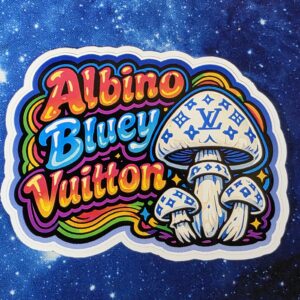
Collecting the family? Add the matching Albino Bluey Vuitton vinyl sticker – and every order includes a free random sticker regardless.
Frequently Asked Questions
What does ABV stand for, and what is it crossed from?
ABV is the common abbreviation for Albino Bluey Vuitton. It is a modern albino isolation, with parentage reported in vendor and community sources as Panama × Melmac PE.
What makes ABV visually distinctive?
ABV is described as a modern hybrid with ghost-pale coloration and pronounced blue oxidation against that pale tissue. The contrast between the near-white body and the blue bruising is the trait most often photographed and documented.
What is the difference between a liquid culture and a spore syringe?
A spore syringe carries spores suspended in solution. Spores are genetically varied and have to germinate before any mycelium exists, so what develops can differ from sample to sample. A liquid culture contains living mycelium from a single isolated genetic line that has already been grown out, so you are working with a known, consistent expression from the start and there is no germination stage. For microscopy and taxonomy work that means repeatable observation of the same genetics rather than a mixed population. Every culture we prepare is made in front of a scanned, 99.99% efficient HEPA filter.
How long will my liquid culture stay viable, and how should I store it?
We recommend using your culture within 2 months of receipt for best results. When stored properly it is covered by our 70-day viability guarantee, and properly stored cultures can remain viable for up to 12 months, although viability beyond 70 days is not guaranteed. Keep it refrigerated between 33-40°F and never allow it to freeze. Most cultures survive a single freeze-thaw cycle, but repeated freeze-thaw cycles will kill live mycelium.
What happens if my culture arrives contaminated or does not work?
Every batch is verified contamination-free before it ships, and your order is covered by our 70-Day Guarantee. If a culture arrives contaminated or fails to perform within that window, contact us and we will arrange a replacement or refund. Full terms are set out on our Refund & Replacement Policy page.
Who created Bluey Vuitton, and where did ABV come from?
Bluey Vuitton is generally credited to a breeder known as Silly Cybin, who is said to have made the cross around 2014 from Panama and Melmac Penis Envy genetics obtained through chance meetings in Santa Cruz, California. ABV came later: during stabilization work on Bluey Vuitton, a pale, pigment-reduced fruit appeared, was cloned, and was worked into a stable albino line.
Is ABV a true albino or leucistic?
The original ABV fruit has been described as leucistic, meaning reduced rather than completely absent pigment, which fits the faint silver-blue tones often seen in its caps. In practice the line is sold and discussed as albino. For documentation purposes, the accurate description is a pale, pigment-reduced Bluey Vuitton selection rather than a guaranteed complete absence of pigment.
What do ABV spores look like under the microscope?
Where prints can be obtained they are dark purple-brown and the spores fall within the normal P. cubensis range. Breeder observations of Bluey Vuitton describe more sterile cystidia and fewer spore-bearing basidia on the gills than in classic cubensis, a pattern consistent with its Penis Envy ancestry, so collections can be light.
Have a question we have not covered here? See our full FAQ page.
Additional Information & Research Resources
Documented Origin & Disputed History
Bluey Vuitton comes with one of the more colorful origin stories among modern designer lines. It is generally credited to a breeder known as Silly Cybin, who is said to have made the cross around 2014. By the most repeated account, Panama prints came from a traveling stranger met on a beach in Santa Cruz, California, and the Melmac Penis Envy genetics came from the same traveler at a later chance meeting before he left for Oregon. The name plays on the luxury brand, reflecting the line’s reputation as a premium, boutique cubensis.
Albino Bluey Vuitton is a later development. During stabilization work on Bluey Vuitton, a spore and genetics outfit reported finding a pale, leucistic fruit, which was cloned and worked into a stable albino line. The Bluey Vuitton story comes from breeder and vendor accounts rather than independent documentation, and we present it as it circulates rather than as settled fact.
What the Genetics Suggest
No published study has sequenced Bluey Vuitton or ABV. The Melmac side places half of its ancestry in the Penis Envy family, which population genomics has characterized in detail. McTaggart and colleagues, writing in Current Biology in 2023, found the P-envy population to be one of the narrowest in cultivation, with the strongest signal of clonal propagation and the highest inbreeding coefficient of any group studied, and placed it on a separate branch from Golden Teacher and its relatives. The Panama side is less well characterized; the same study cautioned that place names on cultivars do not always reflect where the genetics came from.
In plain language: ABV combines one very narrow, well-documented lineage with one less-documented line, then adds a pigment-reducing trait on top. That combination of traits can segregate in spore work, which is why an isolated culture is the reliable way to study one consistent ABV expression.
Why ABV Looks Silver-Blue
The blue and silver tones that define ABV are not a separate pigment. Psilocybin mushrooms bruise blue when psilocin oxidizes in damaged tissue, and in pigmented lines that color is partly hidden by the brown cap. In a pale, pigment-reduced line like ABV, the same reaction shows far more clearly, and faint residual pigment can read as silver or steel-blue on the cap. That makes ABV one of the most useful lines for documenting bruising response, since the reaction is visible almost immediately against the pale tissue.
What Analytical Testing Shows
There is no published laboratory data on ABV or Bluey Vuitton. The closest peer-reviewed reference point is a 2026 study in the Journal of Fungi by Sharchaton and colleagues, which grew 14 cubensis strains under identical conditions. Penis Envy measured 17.59 mg/g total tryptamines and Albino Penis Envy 12.33 mg/g, among the higher results, while totals across the study ranged more than 7.8-fold and individual fruiting bodies within one strain varied by 12.8 to 23.4 percent in psilocybin. PE-family ancestry is associated with higher readings, but it is not a guarantee; ABV potency claims should be treated as unverified until specific testing exists.
Microscopy & Culture Reference Notes
- Spore data: within the normal P. cubensis range where prints can be obtained; breeder observations report dark purple-brown spores, and published ABV-specific measurements are not available
- Gill structure: breeder observations of Bluey Vuitton describe more sterile cystidia and fewer active spore-bearing basidia than classic cubensis, consistent with PE ancestry
- Macro reference: pale white to ivory fruiting bodies, often with silver-blue to steel-blue cap tones; thick, dense stems; heavy, compact build; very rapid blue bruising against pale tissue
- What is observable without spores: vegetative structure – septate hyphae, branching habit and the clamp connections of a dikaryotic basidiomycete
- Suggested workflow: 100x to survey coverage and growth habit, 400x for gill-edge cystidia and basidia density, 1000x oil immersion for spore measurement and clamp connection detail
- Comparative value: run beside Melmac to see which traits come from the PE side, and beside Albino Penis Envy to compare two different pale PE-family lines
ABV on Video
Background viewing from third-party creators. Strain footage first, then the PE family behind the Melmac parent:
- Magic Hour! Albino Bluey Vuitton – Shroom Bloom, 1 min. A time-lapse of ABV fruiting bodies developing, showing the pale tissue and dense build.
- This Run of Bluey Vuitton Is Absolutely Massive – Myco Green Station, under 1 min. A short look at the pigmented Bluey Vuitton parent line and its heavy fruiting bodies.
- Melmac Mushrooms: What Are They? – DoubleBlind, 10 min. An overview of the Melmac Penis Envy line on one side of the Bluey Vuitton cross.
- Penis Envy Mushrooms – DoubleBlind, 7 min. An introduction to the family behind Melmac, and why PE-type mushrooms look and behave differently.
- The True Story of the Penis Envy Mushroom – Hamilton Morris, 2 hr 45 min. A long-form 2022 interview on the origin of the line at the root of ABV’s PE ancestry.
- Fungal Microscopy: How to Mount a Slide, View and Measure Spores – Oregon Mycological Society, 5 min. Not strain-specific, but essential technique for a line where spore collections can be light.
These are third-party videos. We are not affiliated with any of these creators and do not control their content. Links are provided for historical and educational context only.
Important Notice:
Once home, cubensis cultures should be kept in a fridge between 33-40°F to maximize their lifespan. We recommend using them within 2 months. Viability is guaranteed for 70 days when stored properly, and properly stored cultures can last up to 12 months, but this is not guaranteed.
Do not let your cultures freeze! While most will survive one freeze-thaw cycle, multiple freeze-thaw cycles will kill any live mycelium.
This product description is provided strictly for educational, historical, and scientific context. Products are intended for microscopy and taxonomy research only. Not for cultivation or consumption.
We are not able to offer any cultivation or growing information or advice. Any such requests will be ignored.
Please comply with all applicable local, state, and federal laws.
Ryan (verified owner) –
healthy and well packaged, great prices
Joe (verified owner) –
Top shelf genetics, A+ customer service.